
Fighting the Biggest Tier in the Auto Sector: Interview with Lear Parts Workers
“If it wasn’t for IPS plants, the assembly plants wouldn’t have their fucking parts.”
Lear Roscommon workers at Local 1819 recount their shopfloor education campaign and contract negotiations that led to a ratified agreement with substantial wage increases, and points to the need for a bigger unified UAW strategy in the Independents, Parts, and Suppliers sector.
Featured image: Lear Corporation Headquarters. Credit: Dwight Burdette. Used under CC BY 3.0.
This article is part of a series in our initial October 19, 2025 release of Daily Struggle. Read more in our introductory editorial, A Class Struggle Vision: Why UAWD is Launching Daily Struggle.
UAW Local 1819 workers at Lear’s plant in Roscommon, Michigan, organized a contract campaign that resulted in a ratified tentative agreement in July 2025. Rank-and-file workers led a bottom-up political education effort to show the disparity in wage and benefit tiers, not only between Big Three automobile plants and plants in the Independents, Parts, and Suppliers (IPS) sector like Lear, but also between different Lear facilities.
Prior to bargaining, workers received a starting wage of $14/hour, and the plant faced significant challenges of worker retention. Meanwhile, Lear’s CEO made over $17 million last year. The political education campaign successfully galvanized the membership, and put pressure on both management and the UAW’s International Representative who was pushing the Bargaining Committee to settle early. While work-life balance remains a big issue at the plant, the campaign wins highlight the importance of members standing together for a living wage, building a UAW-wide strategy in the IPS sector of the auto industry, and fighting for a National Contract across Lear plants.
Daily Struggle spoke to the following members of Local 1819 to learn about their fight, what they were able to win, and the bigger challenges ahead for their local and the entire IPS sector:
Mark Flaws, Bargaining Committee member; 11 years at Lear
Rhonda VanValkenburg, Financial Secretary; 6 years at Lear, 6 years at Ford
Joe Loftus, Steward; 9 years at Lear
Cal Somers, Rank-and-file; 13 years at Lear, 10 years at other plants
Daily Struggle: Tell us about the Lear Roscommon plant: what does your plant make, how many workers are there, and what were the biggest labor issues facing workers leading up to this contract campaign?
Mark Flaws: We make the Dodge Durango rear seats and Mercedes rear seats. We’re supposed to have about 200 people in our plant but currently have about 160.
Joe Loftus: As far as biggest labor issues, definitely the low pay. We went into negotiations with incredibly, incredibly low pay, at a starting rate of $14/hour and topping out at $17/hour. For comparison, temporary workers in the Big Three start at around $20/hour, and permanent workers start at $25/hour and top out close to $40/hour.
Cal Somers: Okay, after the low pay, you know, we work these ungodly hours, and we’re trying to get more workers into the plant to help us reduce the hours and not have to work so hard. We do multiple jobs, and because of the contract, if we don’t have enough people in certain areas, they’re allowed to pull you. You know, it kind of hurts us being up here in a rural area, because people are so far away, it’s kind of hard to get any people to put in applications.
MF: The plant cycles through 110 people on average per year. They went through the local workforce already. November will be 13 years for me. If you count the people we’re missing, that’s 1,300 people in 13 years.
DS: What do you think is the main reason for that cycling?
CS: Money, you know, because at that time, we didn’t actually make the money we’re making now. And the hours. Eventually, people need to have to be something outside of work… to survive. In other words, you need to be able to drive out to the store to get food, and when you’re working 12 hours…
MF: No family life. If you had kids, you didn’t get to see your kids. Luckily, my girlfriend works at Lear, but most people can’t handle working seven days, and most of those days, 12 hours a day.
DS: Describe Lear as a corporation and its role in the auto industry. How many plants does Lear have (both domestic and abroad) and what is the role of the Roscommon plant?
JL: There’s over 250 plants worldwide, and they’re mostly just manufacturing seating. So, the various components of it, some of it’s the seat frame, some upholstery, some electronics.
DS: How do your working conditions, wages, and benefits compare to Big Three assembly workers? What about other Lear plants?
JL: So, as far as, like, comparison of other Lear plants, this new contract puts us squarely in the middle of the Lear plants, as far as, like, wages, benefits. Except for maybe the Wentzville Lear plant, everybody else is dragging behind the Big Three by a lot. Wentzville is the only one that comes, like, close to them, and even then, they’re not.
DS: Why did workers decide to launch a political education campaign? What message did you try to get across?
JL: The idea was partially inspired by Mark. He said, wouldn’t it be funny if we went up with a bunch of different contract books from all these other Lear plants, went up to management and said, pick one? You know, because all the other plants had better benefits. And I was like, what if I did that with the members?
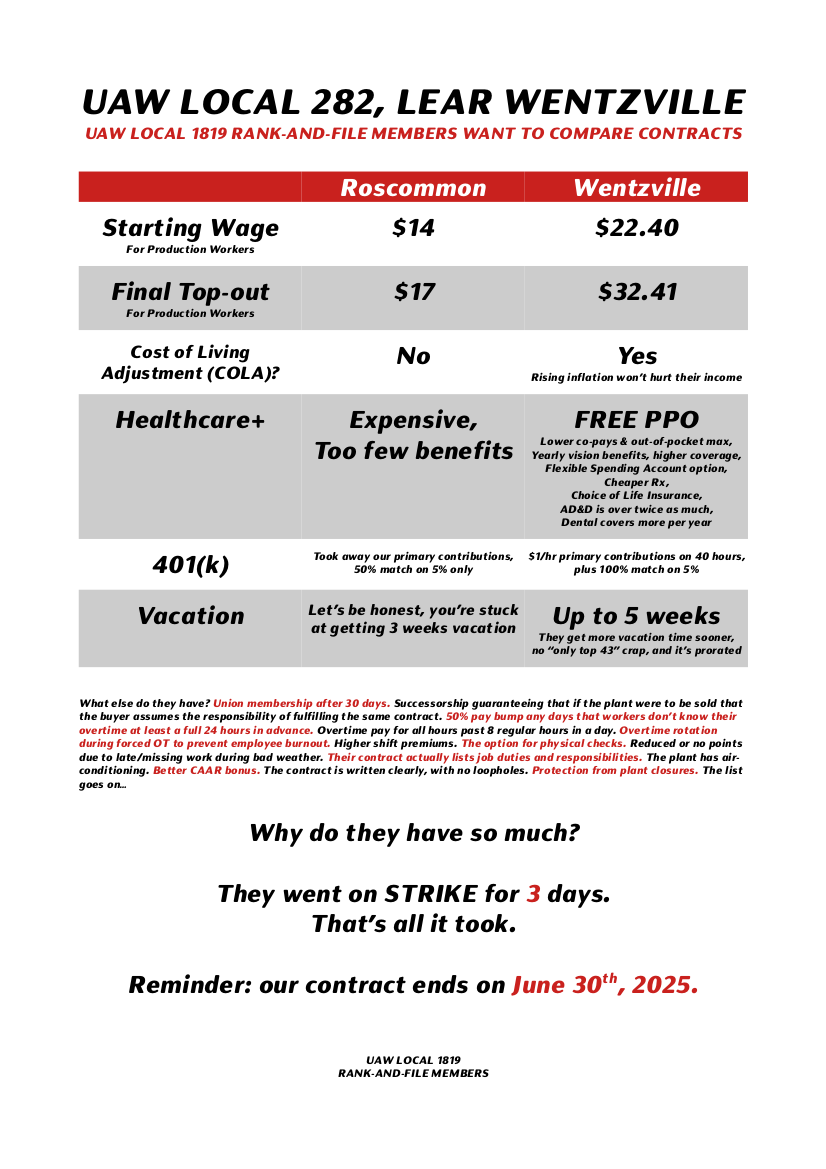
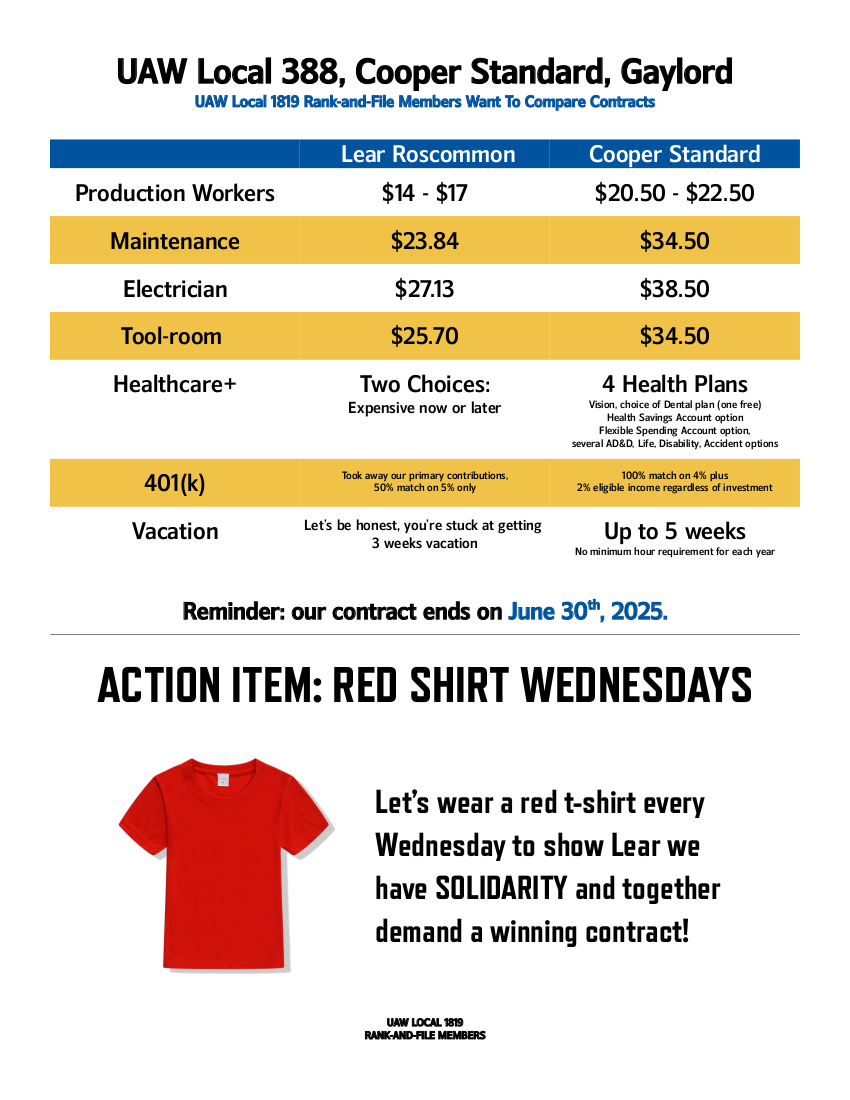
MF: Management wasn’t too happy about the flyers.
JL: Oh, yeah, even our International Rep wasn’t too happy about the Wentzville Flyer.
MF: His first words out of his mouth was… You guys are comparing apples to oranges. [Wentzville] is a seating plant, you’re a stamping plant.
JL: I can say that I flyered in the areas that would not get me in trouble. And specifically so that I would not be hauled upstairs and gotten in trouble. And at one point, I went to lunch, and I come back, and someone had flyered the entire shop floor. Every single workstation had gotten flyered. I got flyered by my own flyer.
Rhonda VanValkenburg: So, the flyer was an awesome idea. It got a lot of people riled up, and it got them asking questions that have never been asked before. Why do you guys want to go for more money? Why do y’all think you deserve this? When we go to UAW conferences, we can see we’re the red-headed stepchild of the union. We don’t make crap compared to some of these people. They come in, they have to tell you about their shop, how much money they make to start, what their top-out is, you know. And we were the lowest paying people out there! And it’s like, we deserve more! We deserve more!
DS: Tell us about the negotiation process. What were the biggest challenges? Did the shop floor campaign help? What did you end up winning?
MF: Management tried to lowball us, but the flyers and shop-floor organizing gave us leverage. Even when the International Rep urged us to accept a lower top-out rate, we pushed for more. We didn’t win everything, but the big change is that new hires come in at $18 instead of $14. Top-out at ratification is $20.50 and will increase to be over $22 by 2028.
Vacation time was a big one. Before, newer workers often ended up with zero vacation in their second year. Now, the system is fairer: 80 hours for 1-5 years, 120 for 5-20, and 160 for over 20. That’s a big improvement. We also secured better 401k contributions, 25 cents for those who previously had nothing, while higher tiers kept their 60 cents. And we’re pushing to eliminate tiers altogether. The contract ended up passing 143 to 22.
It felt like, for once, we could win something by sticking together.
DS: What was the reaction from workers on the floor throughout the contract negotiations? Did management retaliate? How did you push back?
CS: Well, what I thought is, like, it’s not gonna happen, the same thing as always. But once I saw the full contract, I realized we didn’t lose anything. I still voted no, thinking, hey, maybe we could do better. Workers were mostly excited. It felt like, for once, we could win something by sticking together. Management did push back, working us harder afterward, almost as retaliation. Yeah, you guys are gonna work for every penny of this now. And that’s where we’re at right now.
MF: From the bargaining side, we thought the deal was good and wanted a quick vote. We gained $4 raises, eliminated tiers, and avoided higher medical costs. We didn’t lose nothing! But at a membership meeting, the members voted something like 90 to 20 to have two weeks to review the contract. And we actually did win retro pay after that.
CS: You know, I heard a lot of talk about that, because our union wasn’t doing anything for all these years. It was like it was siding with the company. Every time we’ve seen a contract, this is the equipment we’re gonna get, and otherwise, those guys are gonna close up. It’s not that we didn’t trust the bargaining committee, we didn’t trust management. We are so used to having the other shoe drop.
DS: What should the next priorities be in future negotiations?
MF: Limits on consecutive days of work. People shouldn’t be forced into endless 12-hour shifts. Back during COVID, it was suggested that after 15 days you get a certificate for a vacation. We could push for something like that.
CS: We need stronger protections for time off. Members are already calling for no forced Sunday overtime.
DS: Management seems to have retaliated with long hours. Can you push back between contracts?
MF: Surveys show everyone’s biggest issue is hours. HR fails to hire enough people, leaving us stuck working seven-day weeks. We need new hiring practices.
CS: One way to resist is “work to rule,” doing exactly what’s required, no more. That would put pressure on management to listen to us and hire more workers.
JL: Yes, that’s a classic tactic. Between contracts, building shop-floor power and educating members is key. There are really good guides on How to Strike and Win that we should study.
We deserve to be treated as equals. The solution is organizing more Lear and IPS plants. Many aren’t union yet. If more were brought in, Lear would have to negotiate differently. Our CEO makes $18 million a year while workers struggle.
DS: IPS remains one of the biggest tiers in the UAW manufacturing sector. Not only is it a tier compared to Big Three workers, but large wage and benefit gaps persist across the IPS sector itself. What do you think it would take to bring IPS workers to the same level as auto assembly workers?
MF: If it wasn’t for IPS plants, the assembly plants wouldn’t have their fucking parts. Without the metal frame, you ain’t gonna sit just on the cushion. We deserve to be treated as equals. The solution is organizing more Lear and IPS plants. Many aren’t union yet. If more were brought in, Lear would have to negotiate differently. Our CEO makes $18 million a year while workers struggle.
JL: Exactly. You can’t have a Durango without seats. To really move forward, we need a national contract, but that requires much stronger communication and coordination between plants, which is tough right now.
RVV: Unfortunately, there’s little effort from the Region to organize. Some union reps are ineffective, and corruption doesn’t help. Still, organizing more Lear plants across Michigan and nationally would strengthen everyone’s hand in bargaining. There’s a bunch in Michigan that are not organized—in Southfield and Grand Rapids, for example. A next step could be creating a network of union reps across Lear plants, something like a council, so we can coordinate strategy before contracts come up. Right now, communication is mostly informal.
MF: Building stronger local networks between Lear plants is key.
JL: I will be drafting a motion in our Local to formalize that effort. Even without our Region’s support, we can start to reach out and organize with other Lear plants and work towards a national Lear contract.