A Class Struggle Vision: Why UAWD Is Launching Daily Struggle
It’s us vs. them! To face the threats to the working class and build a better world, UAWD believes a vision of class struggle for the UAW is essential. We must advance from individual examples of militancy, cohering a movement that can combat the entire global system of exploitation.
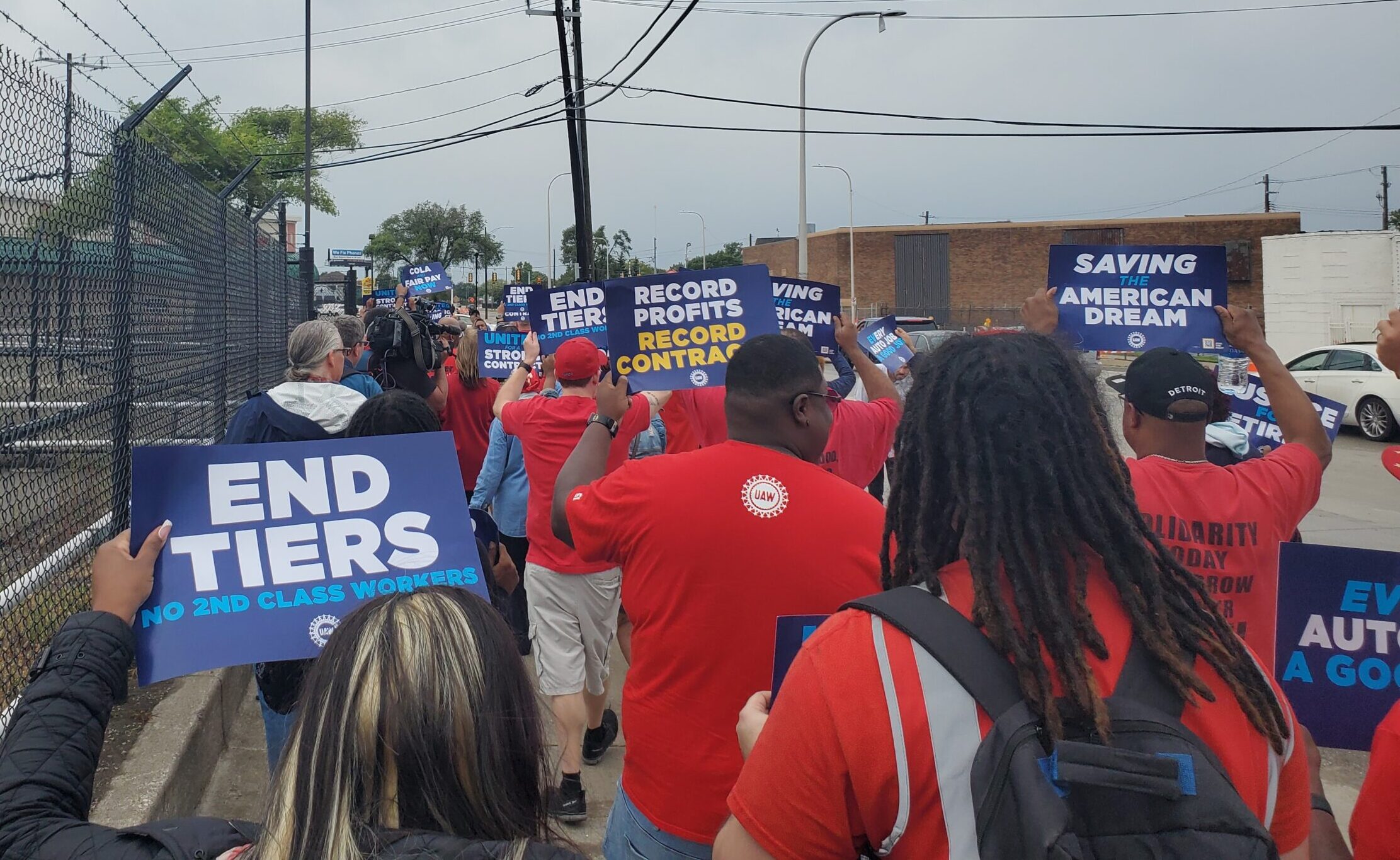
Featured image: Autoworkers picket in Detroit, MI, during the 2023 Big Three strike. Credit: Andrew Bergman.
As part of the initial October 19, 2025 release of Daily Struggle, we are publishing a series of articles that demonstrate the five core values in the UAWD Member Platform, the breadth of our movement, and the types of stories and content we will be featuring:
The power of the US labor movement has been in free-fall for half a century, only seeing some reversal very recently. Even now, union density remains at a historic low of less than 10%. Our union, the UAW, together with a few others, has been at the forefront of a resurgence in militant labor organizing and strike actions. But even as a handful of unions have taken steps forward, the aggressive backlash from corporate bosses and the Trump administration threatens to stop us in our tracks and roll back our hard-won gains. Now is a critical moment. We can either consolidate and improve upon the advances that we’ve made or see them washed away in the latest wave of attacks on the organized power of the working class.
Can the working class movement survive and win a better world for all if it confines itself to reforming the various unions and restricting the battle to the negotiating table? We don’t think so. The enemies—the bosses of the workplace, the boardroom, and the White House—wield their power in every sphere of society to maintain their domination of the world. As workers, we must engage in class struggle to resist the ruling class, drawing on old ideas and developing a new strategy to face them.
At this crucial juncture, UAWD is launching Daily Struggle to champion a rank-and-file-led movement in the UAW that will fight for the entire working class. To share militant tactics that work to win control on the shop floor. To build solidarity across borders and racial and gender divides. To take control over our lives and the resources and infrastructure we rely on to live, both at work and in our communities.
How We Got Here
The UAW leadership has a history of collaboration with the bosses, a departure from the radicalism and militancy of its early years. UAW President Walter Reuther brokered the “Treaty of Detroit” with GM in 1950, abandoning the union’s commitment to industrial democracy and worker control. Instead our union positioned itself as a collective bargaining body fighting over details of wages and benefits only once every few years, while collaborating with corporate rule to minimize work stoppages and settle disputes through a bureaucratic grievance procedure. Contracts were negotiated on the assumption that workers and employers had a shared interest in improving productivity, and thus increasing profits—that higher profits would benefit workers in the form of rising wages and a steadily improving quality of life. For a short while, thanks to favorable federal policy and the US’ dominance in the global economy after World War II, this strategy reaped material benefits for US workers, but at the cost of shop-floor power and international solidarity.
We all know from our day-to-day experience, too, that the relationship between management and workers is an antagonistic one—a daily struggle.
The happy illusion of class collaboration began to break down in the 1970s. Some simple numbers demonstrate how American workers have been served by their unions’ deals with the bosses: In 2023, the richest 1% of the population took home 182% more than they were making in 1979, while wages for the bottom 90% only grew by 44% in the same period. The top 0.1% of earners make a staggering 354% more. Over these same years, workers’ productivity increased by 80%. It’s clear that the benefits of rising productivity have gone to the capitalists, while workers receive a dwindling share of the value that our labor produces. That’s only been possible because employers, as a class, have been organized, have consolidated their political power, and have been relentless in advancing their own narrow interests—at everyone else’s expense. The result: stagnating wages, declining quality of life, increasing financial insecurity, weak unions (where there are unions at all) and politicians—Democratic and Republican alike—who calculate that they don’t need to be accountable to workers, that lip service and empty promises are enough to buy us off.
Since 1979, the top 1% and 0.1% of earners have seen their income in real dollars increase 188% and 354%, respectively, while the bottom 90% have only seen a 44% increase.

Workers produce more value every year, but their compensation lags further and further behind.

We all know from our day-to-day experience, too, that the relationship between management and workers is an antagonistic one—a daily struggle. Whether it’s being denied sick leave or breaks, being sped up, overworked, made to work in unsafe conditions, or simply being underpaid, we’re reminded in a thousand ways every day that, to them, each of us is no more than a means of making a profit. And if they find that they can make a bigger profit without us, then, as far as they’re concerned, that’s just our tough luck (and their managerial talent).
Conditions Today
Today the concentration of wealth and power has reached a degree unknown for at least the last century. And we see the effects of that concentration in everything from rampant price gouging and the reckless destruction of the environment to unchecked attacks on workers’ rights and the breakdown of basic democratic norms. It shouldn’t surprise us. This is what can be expected when our lords and masters—the executives, the bankers, and the boards of directors—use the political power that their control over the economy gives them to advance their own interests. But it’s to the detriment of everyone else and even of the long-term viability of our society, especially when nobody fights back.
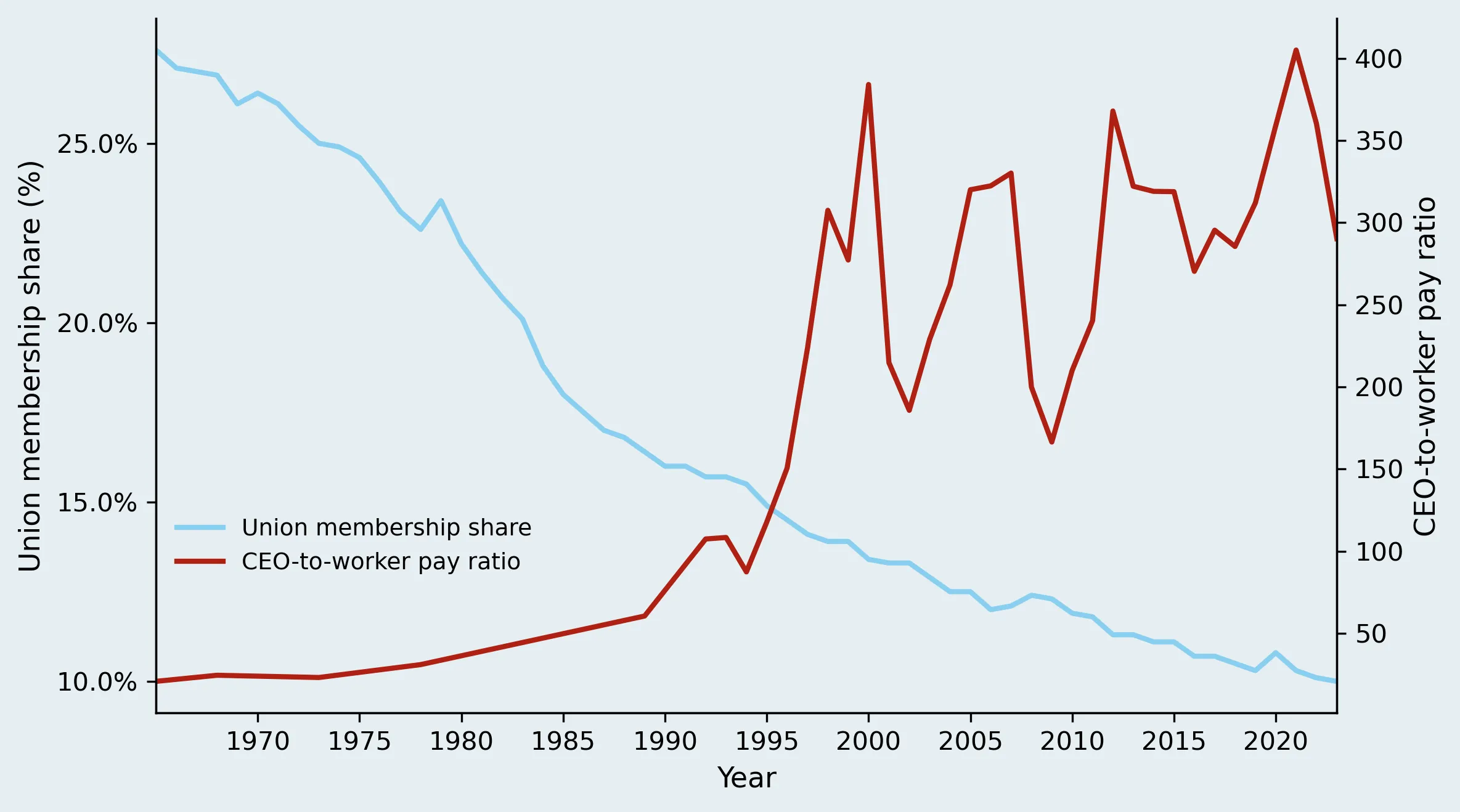
Union membership has declined in recent decades, while CEO salaries have ballooned relative to worker compensation.
The rich are putting our world at risk from the comfort of their gated communities—or luxury bunkers. The affluent middle class lacks the political will to do anything other than wring their hands and pray for the good old days to return. That places a monumental responsibility on our shoulders, the shoulders of the working class. It’s one that we should bear proudly, as generations of workers before us have. Our struggle—for dignity, democracy, and equality; for free, full, and decent lives; and against the exploitation of workers and the degradation of work—isn’t ours alone. It has been said that “The cause of labor is the hope of the world.” Because our work is the source of the wealth with which the ruling class purchases its power, we alone are in a position to take back the power that is rightfully the people’s and to ensure that it is exercised in the interest of society as a whole.
UAW members are at the center of the struggle today. We need to realize this and act accordingly. Our industries are on the frontline of the class war being waged by our bosses, our bosses’ bosses and the politicians they buy, against workers, our families and our communities. In the auto sector we’re continually threatened with layoffs and plant closures, and now with added insecurity due to the President’s trade wars and cancellation of clean energy subsidies. UAW members in the education, legal services, and nonprofit sectors have lost their jobs for protesting the US-backed genocide in Palestine. Higher education workers are facing intensifying austerity measures, resulting in more work and fewer jobs. Our immigrant siblings, together with their children, are being swept up indiscriminately by masked agents of a racist and thuggish state, with labor organizers often being targeted.
The lack of any serious response by organized labor to the attacks on our unions, our rights, and the very principles of democracy and equality since the start of Donald Trump’s second term points to the need for a renewal of independent working-class militancy.
Across the country, workers are engaged in the fight against racism and policy brutality, misogyny, anti-queer bigotry, and ableism—too often without the support of our unions. At the same time, the National Labor Relations Board is being stacked with anti-union goons and starved of resources, while its very existence hangs in the balance. Federal workers’ collective bargaining rights are being shredded, and thousands of government workers have already lost their jobs. Our blood and treasure are wasted in wars and imperial adventures while regular people, including veterans, struggle to meet their basic needs for housing, health care, energy, transportation and food.
The lack of any serious response by organized labor to the attacks on our unions, our rights, and the very principles of democracy and equality since the start of Donald Trump’s second term points to the need for a renewal of independent working-class militancy. So long as we wait for somebody else to stand up for us, things will only get worse. We have to come together and fight. Our self-respect demands it.
UAWD’s Pivot to Class Struggle
Unite All Workers for Democracy (UAWD) started out in 2019 as a caucus with the intention of reforming the UAW. In the decades since the Treaty of Detroit our union, under the uninterrupted control of the Administration Caucus, developed the sicknesses with which we’re all too familiar: corruption, concessionary contracts, and a bureaucracy unresponsive to rank-and-file members. Notably, UAWD led the successful One Member One Vote campaign, leading to the first direct elections of the union’s leadership by rank-and-file members, and with that the end of the Administration Caucus’s 75 years of unchallenged control over the UAW.
After our successes, a series of political disagreements over whether we should present an honest assessment of the 2023 Big Three agreements or uncritically campaign for them led to the eventual breakup of the coalition that built UAWD. Some UAWD leaders illegitimately attempted to dissolve UAWD following a struggle over whether to become an arm of the Fain Administration or to maintain the fight for an independent class struggle vision for the UAW. This year UAWD took a step forward by adopting a Member Platform that establishes a renewed commitment to building a fighting labor movement that will challenge the rule of the corporate class at every level, from the shopfloor to the halls of power.
Class struggle unionism is, in fact, alive today in the UAW and other unions, but not at the scale that is needed to take on today’s global oligarchy. You can find it wherever you see workers fighting for control over their lives, whether on the shop floor or beyond it. Building a labor movement capable of confronting today’s challenges requires, in the first place, recognizing where workers’ initiative is already moving in that direction, telling those stories, and learning from them. Stories like: when workers file a group grievance with a union steward at a tactical time to delay production because management is overloading jobs. Or when workers in a department employ work-to-rule or “go fishing” because the boss refuses to fix a health and safety issue. Or, recently, when New York City legal services workers organized a sectoral strike to win their demands.
In short, class struggle unionism is an approach to labor organizing that recognizes workers and bosses as having fundamentally opposed class interests, and believes that militant and democratic collective actions, such as shop floor confrontations and strategic strikes, are needed to challenge capitalist power and to take control of our working lives.
What’s needed now is to advance from isolated examples of working-class militancy to combating the entire system that generates immense wealth for the few by exploiting the labor of the many. With that end in view, we are launching this publication with the aim of helping UAW members to chart a way forward for our movement. First and foremost, it will be a medium for members to educate each other by sharing their knowledge and experience. UAWD believes that power comes only through organizing from the bottom up in our workplaces and our locals. At the same time, we need to understand the systems within which we operate: the political economy of the US across different sectors, the UAW administration, and the role of political parties. The articles that we will publish, which will be written by UAW members, will demonstrate the breadth of our class struggle approach by drawing the links between these systems and what we experience at work, in our communities, and in our union.
Nothing happens in isolation. We must recognize the broader picture and develop a unified strategy. This is a necessary step away from exhausting our energies in endless uphill battles in a system that’s set up for us to lose. We have to be taking on that system as a collective working class and fight to win.