Industrial Organizing in New York City’s Cultural Sector
With high union density, workers at New York City’s numerous nonprofit movie theaters can look beyond single-employer negotiations. We can develop an ambitious sectoral strategy to wrest control over our work from bosses and billionaire donors, fundamentally changing how arts nonprofits operate. The leverage is there, but to use it to build power, workers in the sector will have to break old habits and take things into our own hands.
Since 2019, there has been a remarkable upsurge of worker organizing in the movie theater world of New York City. June 2019 saw the opening salvo of a series of successful unionization drives, resulting in six new bargaining units, all of which have found their home in UAW Locals. In the nonprofit sector, housed in UAW Local 2110, Brooklyn Academy of Music (BAM) was the first, followed shortly thereafter by Film at Lincoln Center (FLC), Anthology Film Archives (AFA), and Film Forum (FF). These workplaces joined the Museum of Modern Art (MoMA), which first unionized in 1971 and was folded into Local 2110 when District 65 merged with the Local in 1992.
Movie theater workers in the private sector have also been galvanized and have led successful campaigns at Alamo Drafthouse and Nitehawk Cinema, where workers are now represented by UAW Local 2179. The anti-union rhetoric and union-busting tools used in the private sector, including captive audience meetings, have been more devastating than those used by management in the nonprofit sector, which is reflected in the smaller margins of victory in their elections. Some private owners took extreme measures, leading to a difficult loss at Cinema Village, where all the workers involved in the unionization effort were fired and replaced, their campaign effectively quashed.
The individual successes of these drives are absolutely worth celebrating. However, seven years into this upsurge of labor organizing in the movie theater sector, it is clear that our union lacks a long-term vision for harnessing our collective strength and the power of our labor in this regional industry. Workers in Local 2110, led and trained by Local union staff, have bargained their contracts without engagement or alignment across workplaces. The Local is in a constant carousel of contract expirations and re-negotiations, and our strategic vision has remained firmly stuck in the narrow groove of bargaining for higher wages and better benefits. So long as we stay stuck in this groove, our unions will continue fighting for scraps in a nonprofit industry that in recent decades has been starved for investment by federal, state, and local legislators.
Declining public funding for the arts
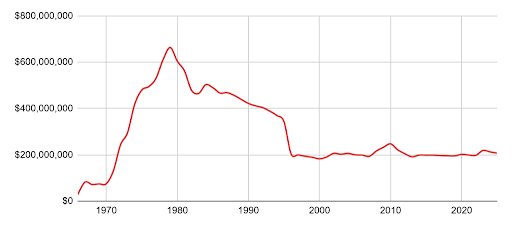
Federal arts funding has been cut repeatedly by both Democratic and Republican administrations, most notably by Reagan in 1982 and Clinton in 1996. Adjusting for inflation, annual appropriations from the National Endowment for the Arts (NEA) have remained completely flat since 1997, down to 30% of their 1979 peak. In a recent testimony before the New York State Assembly, Rachel Neches, a data and policy researcher, observed that the “New York State Council of the Arts grantmaking budget, which provides operating grants that are so crucial for the survival of small and mid-sized arts organizations, remains 37% below its peak 1990 level, adjusted for inflation. Meanwhile, funding from the National Endowment for the Arts to New York has declined over the past two decades and now faces the threat of elimination.”
With declining public funding, nonprofits increasingly turn to private donors and foundations, which puts more and more infrastructure for the cultural lives of New Yorkers in the hands of a wealthy few. Increased funding for New York City’s Department of Cultural Affairs, which provides funding to cultural nonprofits through its Cultural Development Fund, and the recent creation by NYC Mayor Zohran Mamdani’s administration of a $10 million “Cultural Stability Fund,” which provides emergency funding for organizations beset by unexpected circumstances, are steps in the right direction but fall short of what workers could win from the bottom up. Disbursements from the Cultural Stability Fund will still go through a top-down process administered by the Department of Cultural Affairs and our bosses. A union-run job bank and a work-sharing program would be a similar lifeline but under workers’ own oversight.
What we can win
Fighting over issues that affect an entire sector requires a strategy that will mobilize workers across the industry. UAW membership in the nonprofit movie theater industry in New York City currently includes a critical mass of workers that could spearhead such an effort. On any given evening, about 50% of all showings listed on ScreenSlate are happening on nonprofit screens. Of these, about 87% are happening in union workplaces. (This figure undercounts 2110’s footprint, as BAM’s regular screenings are not posted on ScreenSlate.). This is a remarkable saturation of an industry, and the power that it gives us could be wielded by workers for any number of goals. However, the approach taken by the 2110 Executive Board and staff over the last five years has failed to harness this power to any substantial political aim. So long as the Local keeps our shops’ struggles separated and workers at arm’s length from one another, we will be unable to utilize our power on the shop floor to bring about systemic change.
Broad-based, cross-workplace militancy needs to be developed for workers in this newly unionized sector to use our power to enact social change beyond the boundaries of any single shop.
Broad-based, cross-workplace militancy needs to be developed for workers in this newly unionized sector to use our power to enact social change beyond the boundaries of any single shop. By uniting across workplaces, members can elevate our fight to an industrial scale, breaking free of the limitations of single-employer negotiations. Industrial organizing can be developed in Local 2110 through a contract alignment campaign. With our contracts aligned to expire on the same date, our ability to strike would not just threaten the operations of a single workplace but, by affecting the entire sector, could be leveraged to win political and economic demands that extend beyond any one workplace.
With the power of industrial organizing, what more ambitious demands could be won? There is the possibility of making demands on the mayor’s office about nonprofit and arts funding more broadly, which would mean pairing our contract campaign with a particular policy demand. We could win worksharing arrangements, where workers at one job could move to other venues when our schedules are affected by closures, layoffs, or slow seasons. We could unify wage structures across workplaces, or establish pensions or guarantees about our schedules and hourly minimums for part-time staff. By pairing these economic demands with a political demand for increased public arts funding in NYC, we would be able to utilize our labor power to enact social change. Winning such demands would require that workers be ready to take militant strike action and assert our political independence, since it’s possible we would face legal injunctions from the state and condemnations from otherwise friendly elected officials.
What it would take to win
The stakes are very serious, so workers must be correspondingly serious about strike preparation and take time to build trust in one another and commitment to our goals. Winning such demands would fundamentally alter the way the nonprofit movie industry in NYC operates, and it is likely that victory could be achieved only through a strike that halted arts screenings across the city. Based on current contract lifetimes, the most realistic date to align the expiration of our contracts would be June 30, 2029, which would give us three years to develop our tactics and engage members at all workplaces to unite behind key demands. We would need to use the time between now and then both to steel ourselves and to develop support from our communities and regular attendees, to ensure that movie lovers in NYC join us on picket lines with an understanding that this struggle is about freeing, if even just a little bit, arts funding from the hands of a wealthy few.
Developing, and ultimately winning, such a campaign requires worker-led organizing by rank-and-file members at every workplace. This would begin with workers meeting and developing shared support across workplaces around a unified tactic like contract alignment, which would require regular engagement and public meetings with members of all affected workplaces, to develop collective buy-in for a different and more militant approach to contract negotiations.
Not only is this kind of campaign possible with the workplaces we have in our Local, but it is absolutely necessary in order to prevent calcification and a long, slow slide into service unionism and general irrelevance to rank-and-file members. New York City’s working class is facing a mounting series of economic crises. We must use every tool at our disposal to develop militancy in the fight against our bosses and the owners of capital to fix the systemic failures that have brought us to this point. This article has focused on nonprofit movie theaters in NYC, but the patterns described above exist at museums and other nonprofits organized with Local 2110. Workers organizing on a class struggle basis can overcome these problems and chart a new path forward, for our workplaces and for the way the nonprofit industry in our city operates.
If you are a Local 2110 member interested in developing a sectoral strategy, contact us or become a UAWD supporter.
Featured Image Credit: Nevena Pilipović-Wengler