Struggling Against Industrial Peace: Transforming Grievances from Roadblocks into Shop-Floor Action
It’s time for the labor movement to stop glorifying the grievance procedure and start understanding its role in pacifying the rank and file. Union members need to take grievances out of the office and onto the shop floor, using them as just one tactic in a larger strategy for workers to exert more control on the shop floor.
This article was written with input from rank-and-file members of Local 22.
Grievances are one of the main tactics that union leadership in the U.S. declare that they use to “fight” the boss. The grievance procedure has been an “almost universal” feature of collective bargaining agreements since the 1950s. While filing grievances does sometimes succeed in keeping management in line and ensuring that contracts are observed, it is ultimately a tool the bosses use to shelve issues and diminish shop-floor conflict. The adoption of the grievance procedure as the preferred way to resolve disputes upholds an illusion that there is no fundamental conflict between the interests of workers and those of management, merely contract violations that can be handled without confrontation and without disrupting production.
It’s time for the labor movement to stop glorifying the grievance procedure and start understanding its role in pacifying members. When workers have established that they’re ready to take action on the floor and slow or stop production as a collective, grievance procedures can play an important role in enforcing contracts. But filing a grievance is not the same thing as fighting the boss, and we shouldn’t mistake one for the other.
Looking Back to the ‘40s: Grievance Procedures vs. Shop-Floor Struggle
Formal grievance procedures spread rapidly in the 1940s and 1950s, turning shop-floor struggles into bureaucratic processes. The timing is no coincidence: the late 1940s, culminating in the 1950 Treaty of Detroit, marked the end of a long stretch of labor militancy and fierce struggle between workers and management, and the beginning of a new era of “industrial peace.” This era has seen a continuous decline in union density, which today is at an all-time low, coinciding with a steady rise in income inequality from its historic low in the first half of the 1950s. In short, “industrial peace” has been good for the capitalist class and bad for the working class.
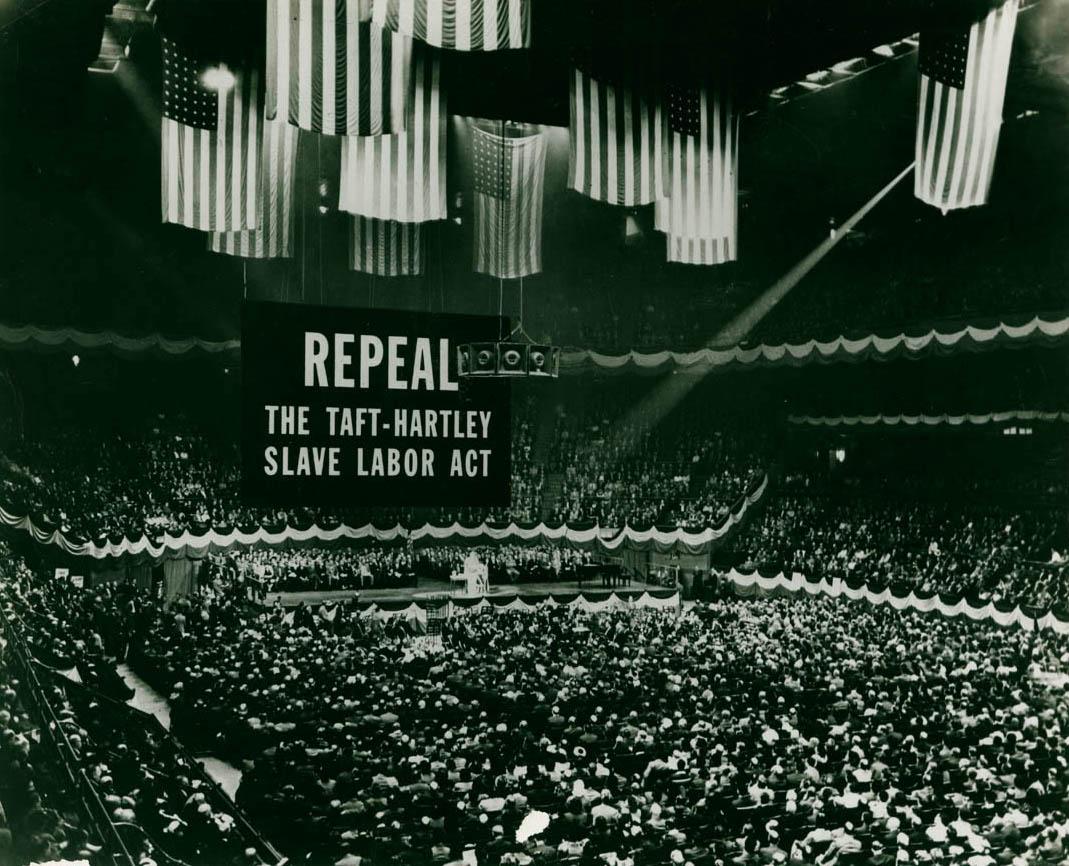
The spread of grievance procedures coincided with wartime measures (like the National War Labor Board) that pacified unions and formalized relationships between union leaders and bosses, the purge of communists—who were typically the most dedicated organizers—from unions, the introduction of no-strike/no-lockout clauses, and the enactment of laws regulating relations between unions and management. While the National Labor Relations Act (NLRA) of 1935 enshrined collective bargaining rights for the first time in U.S. history, the amendments to the NLRA known as the Taft-Hartley Act (or, as workers at the time called it, the Taft-Hartley Slave Labor Bill) of 1947—which was passed in reaction to the strike wave of 1945-46 and put severe limits on the causes for which workers could legally strike—upheld the principle of collective bargaining and the freedom to unionize but made explicit that the intention in doing so was to put a damper on “[i]ndustrial strife which interferes with the normal flow of commerce and with the full production of articles and commodities for commerce.”
Taft-Hartley exemplifies what has been the strategy of the capitalist class from the late 1940s to the present: recognize in principle the right to unionize, while stripping organized labor of its leverage, which lies in the ability to disrupt production.
It’s telling that more militant unions at the time rejected the adoption of formal grievance procedures. For example, the Farm Equipment Workers Union (FE) rejected the procedure entirely, and they had one of the best contracts of all unions at the time. When management violated the contract, FE members would get pissed off and talk with their union steward, and the steward would tell management:
“Well, I’ll tell you right now. It’s not just him, it’s the whole department. When that bell sounds at 7:30 and they go on their break, they’re going to have a meeting. If you haven’t straightened it out, you won’t have any pieces from anybody the rest of the night, because they’re going to go home. They’ve already told me that.” (Quoted from Toni Gilpin, The Long Deep Grudge, p. 207.)
FE recognized that their union’s power was on the shop floor, and that in order actually to make management bend towards the workers’ demands, they needed to keep the fight on the shop floor through credible threats of work stoppages.
How Grievances are Used to Pacify Workers Today
Grievances are often initiated by workers, but once a grievance has been written up, workers are often pushed out of the process as union officials meet privately with management to “strike a deal.” Workers, meanwhile, go back to work, ensuring that not a moment of profit-making is lost.
The most significant limit of the grievance procedure is that it suggests there can be a resolution of a contractual violation without resorting to what makes our union actually powerful: our numbers and our ability to stop work.
Grievances tend to emphasize individuals and silo workers off from one another. The procedure encourages workers to address their issues as individuals, communicating solely through their union steward, rather than organizing a group of fellow workers. Even the best steward only gets so far in fighting management by representing one person at a time. What’s more, it turns “fighting the boss” into a bureaucratic procedure, protecting bosses’ profits and power.
The most significant limit of the grievance procedure is that it suggests there can be a resolution of a contractual violation without resorting to what makes our union actually powerful: our numbers and our ability to stop work. Grievances are often settled quietly and “professionally” in an office, or, even worse, through union leadership horse-trading with management. When grievances are filed with no threat of action, the process is often ignored or co-opted by management, yielding results only when bosses want to give union leaders they’re close with a small victory.
Transforming Grievances from Roadblocks into Shop-Floor Action
Unlike the Farm Equipment Workers, the majority of workers across the U.S. are terrified to engage in shop-floor struggle. There’s an undeniable reality that the NLRA and its federal labor protections give members some sense of protection, and that the formalized grievance procedure, facilitated by a union steward, helps boost workers’ courage to take action.
But in order to engage in a meaningful fight with the bosses, the grievance cannot be seen as the fight—it must be utilized as a tactic in a larger strategy, collectively organized by rank-and-file members. Two examples from the author’s auto assembly plant, General Motors’ Factory Zero, show how members did just that.
Because the workers used shop-floor action to back up their grievances, they gained the courage that comes with knowing that they had each other’s backs. As one worker said, “We can be scared of them, or they can be scared of us.” Now, when members call for their steward, management often addresses the issue before she even has to show up.
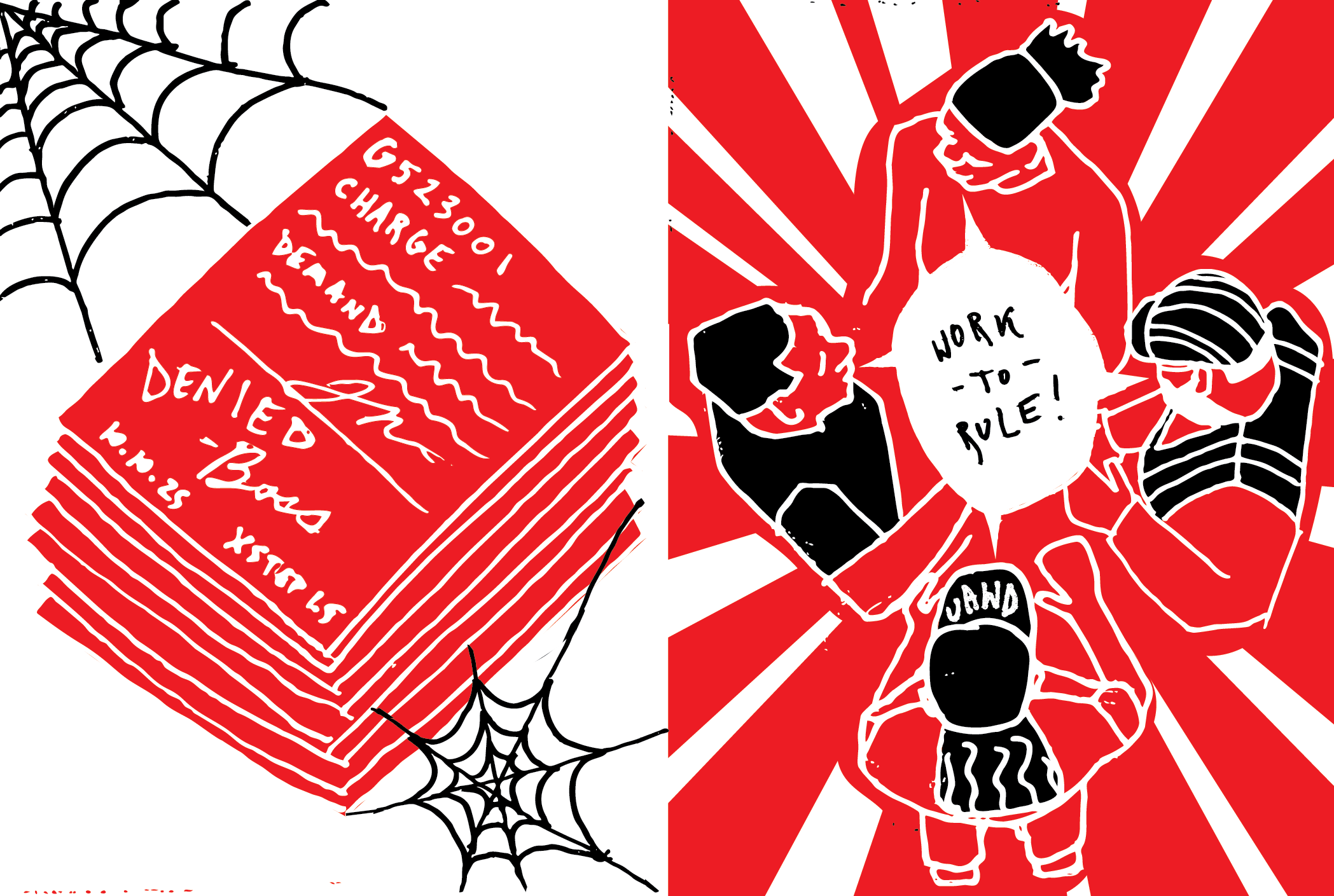
In the first example, workers decided to file multiple group grievances against management for understaffing their team and won them by carrying out a work-to-rule campaign. The issue had been going on for months, but when management started making some workers do two jobs while laying off other workers, members took action.
In their work-to-rule campaign, workers did exactly what the boss’s rules say about their jobs—nothing more and nothing less. For example, when put on two jobs, one worker would hand in their walkie-talkie for their original job to a boss, physically making it impossible for the worker to do both jobs. Other workers hassled management over their job descriptions, showing management that their own paperwork was incorrect and making the bosses scramble to prove that their own orders were by the book. During the campaign, workers knew that management would take any opportunity to retaliate, so they were extra careful when it came to things like tardiness or phone use, making sure not to give management an excuse.
More confident members stepped forward publicly as leaders, so that other members would know who to turn to. And they coordinated this plan with their steward, so that she would be ready to show up whenever management escalated. To show their solidarity and support for the grievances that were filed to address the staffing violation, workers all wore red on the day that the steward had the grievance meeting with upper management.
Ultimately, management found the work-to-rule campaign more damaging and disruptive to production than the savings they had made by cutting the number of workers. The workers reversed understaffing and won back the jobs that had been removed—but they won much more than that. Because the workers used shop-floor action to back up their grievances, they gained the courage that comes with knowing that they had each other’s backs. As one worker said, “We can be scared of them, or they can be scared of us.” Now, when members call for their steward, management often addresses the issue before she even has to show up.
In the second example, workers won back break time that management took away from them by making tactical use of the grievance procedure itself. Often the grievance procedure involves a lengthy process as paperwork is pushed from one step to the next. But when management violated the contract by changing workers’ breaks without union approval, workers used the lengthiness of the grievance procedure to their advantage.
Workers seized the rescheduled break by passing paper down picnic tables for members to sign up to request a “call,” or a conversation, with their steward, a right that members have under many contracts in assembly facilities. Almost 60 members added their names, and, as a result, the steward had to make all 60 of those calls. This effectively took back hours of production from management, since the sheer number of calls the steward had to answer by taking workers off the line to speak with them, one-on-one or in small groups, overwhelmed the bosses and stopped production. Some of the calls led to grievances that either won back the break time or were used in exchange to win other grievances. But most importantly, it revealed a creative way that workers can use grievances to bring heat to the shop floor.
Looking Forward: Trading in Bureaucracy for Militancy
As the successes of the FE prove, shop-floor militancy is the most powerful weapon the working class has to change their working conditions. Most workers today may not be ready to confront management the way FE did. But union members can utilize grievances as opportunities to strategize collectively and take their own initiative to put pressure on management. Doing so will help to build up the muscle required for escalations like walk-outs and mass strikes, which will be necessary for workers to fight for control in their workplaces and in their communities.
Reliance on grievances keeps us from understanding how much power workers have when we come together and take things into our own hands. Instead, utilizing grievances as tactics in a larger campaign will help politicize members, break down bureaucratic rigidity, and demonstrate that keeping the peace with management by diverting struggle into paper pushing and “office meetings” doesn’t help the working class but actually holds us back.
Featured Image Credit: Nevena Pilipović-Wengler