“Just Fucking End It!”: Walkouts over Forced Overtime
Workers are walking out at non-union Toyota plants in Alabama in response to forced overtime and rotating shifts. Can the fight to take back our time be a lightning rod for union campaigns?
A few months ago, there was a short, small strike at Mazda Toyota, the non-union auto plant in Alabama where I work. It was on a Friday afternoon, and it was our last day on day shift, before switching to nights the following week. The strike happened because management called half an hour of mandatory overtime, and nobody wanted to stay.
Half an hour isn’t much (they often call more). It came as a surprise, though, since previous company policy said that on the Friday before a shift change there would be no overtime.1 And people were furious about it: almost everyone here hates working late even on normal days, but this time management was changing their own policy without any notice. Some people had probably made plans. Most of us were just angry about the principle.
So one part of the plant walked out, and another organized a work-to-rule. I was in the wrong area and didn’t hear about what happened until later. Where I was, a lot of people talked about a walkout, trying to judge who would go with them. We didn’t get it to happen that day, but it’s happened a few times in the past and always because of mandatory overtime.
“Some circle of hell”
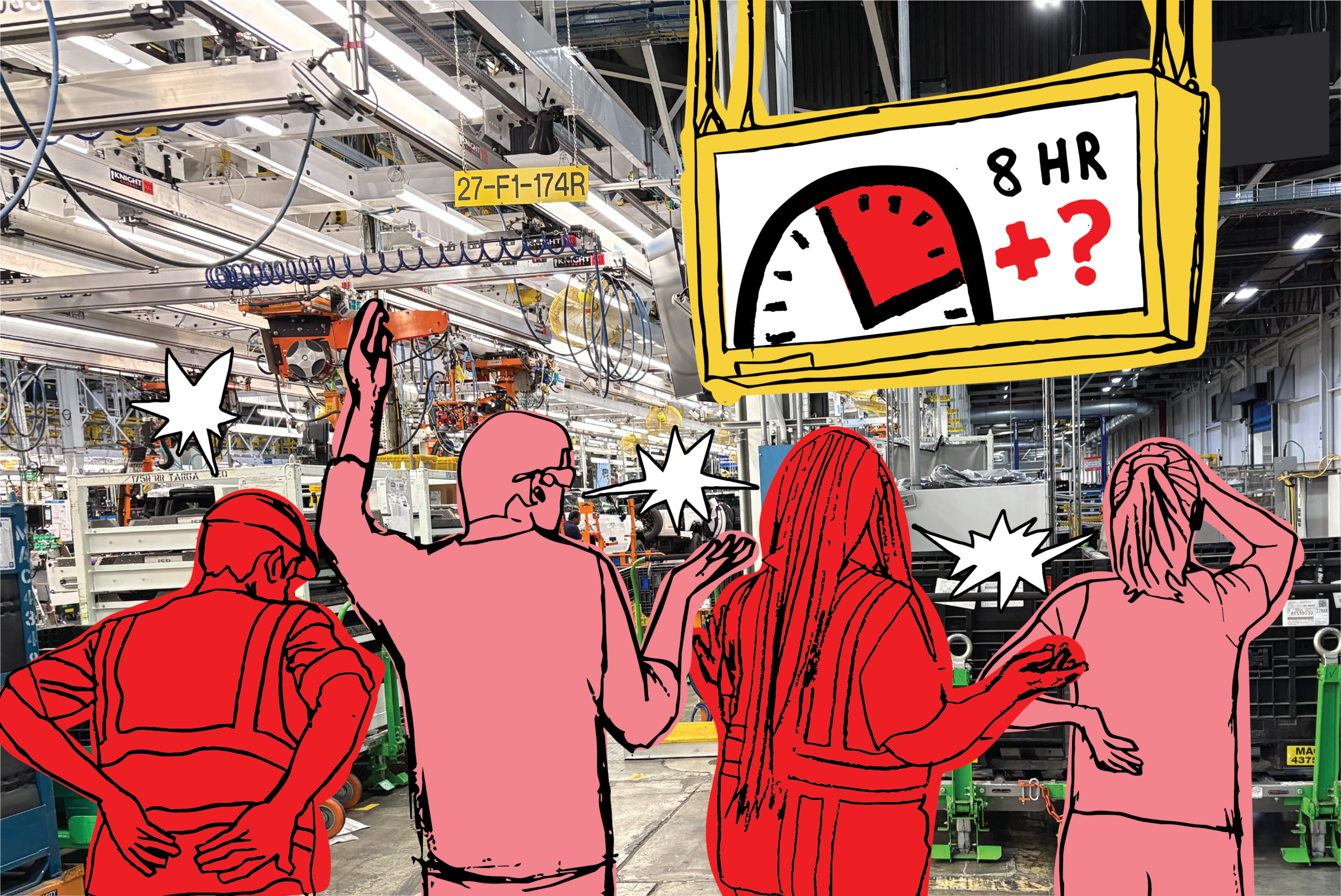
In my experience, there is nothing that gets people angrier than being held at work against their will. It happens almost every day in a lot of manufacturing facilities: whenever a machine goes down, a part is missing, or demand goes up. In Alabama people will talk about it like it’s prison or slavery. On night shifts the atmosphere becomes almost feverish. A friend of mine likes to joke about running out in front of a fork lift. “I volunteer as martyr!” she’ll shout. “Maybe if I die, they’ll let the rest of you go home.” One guy looks up at the board where they announce overtime and shouts, with his arms raised like he’s being crucified, “End it! Just fucking end it!”
This kind of energy is too electric—too intense and reflexive a reaction to management trying to spit in your face—to be channeled into a campaign around pay and benefits. Of course people want a raise. But auto jobs are the best paying jobs there are for workers without college degrees, and what drives people crazy is that management thinks they can work you to death as long as they give you a few extra pennies for it. One coworker I talked to about this article described the experience as follows: “It feels like torture, even more than it feels like prison or slavery. It feels like you’re being held in some circle of hell and punished for the sin of greed.”
A lightning rod for new organizing
The people trying to organize a union at my plant are the ones who refuse to be treated in this way. It’s not that many people, compared to the number who just walk out or quit, but there is still a strategic lesson to be learned: class struggle often starts with a fight over hours or company policies, rather than pay or benefits, since the stuff that happens at work is what you get angry about, and talk to people about, every day. You can also do something about it just by getting together a few people on the floor. Anytime management tells you and your coworkers when or how to do your job, you can negotiate with them—or say no and risk the consequences.
There is also another lesson: conflict over hours is uniquely explosive. Of all the things that piss people off at my plant—the uniform policy, the bathroom policy, every other dumb thing they tell you to do—the fight against mandatory overtime is the one that will halt the line if you follow through on it. This is what gives you leverage. Nothing really matters to management except how many cars they sell.
These theories are borne out by the fact that many of the most militant, worker-led union campaigns in the last few years have been centered around overtime or the length of the workday. U.S. workers currently spend almost 20% more time at their jobs than they did in 1960—the equivalent of an extra workday—and in response there have been strikes by Kellogg’s workers working sixteen hour days and by Boeing machinists working nineteen straight 10-12 hour days, mid-contract walkouts by CWA bus manufacturers due to violations of overtime policy, and a recent hunger strike by SEIU home-care attendants fighting 24-hour shifts, along with who knows how many other less well-publicized campaigns.
Right now, these campaigns are isolated. Often they are opposed by union leadership, precisely because by interfering with production they threaten peaceful relationships with management, and there has not yet been any decisive victory. Still, you see them all around. They just have not yet coalesced into a movement.
A campaign to organize the South
It briefly seemed like such a movement was possible when Shawn Fain was elected president of the UAW. At the 2024 Labor Notes conference, right after the Stand Up Strike, Fain argued that what unites workers across sectors is that we are forced to give up our time to our employers. At the same conference, he launched the campaign to organize Southern auto plants with a promise to fight for the four-day week.
The UAW’s momentum has since stalled: partly the terrain, partly Fain’s strategy and political orientation. A fight over how long we have to stay at work, however, is already taking place at auto plants across the country—and it goes far beyond the spontaneous walkouts that happen at my plant. At Rivian in Indiana, worker organizers are refusing to follow UAW leadership’s advice, pointing out that a strategy built around profit-sharing makes no sense if your primary issue is who controls the schedule.
And just a few weeks ago, workers at the Toyota engine plant next to mine organized a sickout that slowed their line: they did it to fight shift rotations, since (as one organizer and UAWD member, Randall Coggin, put it) of all the issues at the plant, “this is a thing that bothers everybody.” In conversation, Coggin added: “This is how we’ll win the struggle against capital in the South, taking back our time and our lives. They only value our time as a thing they can use, but workers are tired of being treated like the machines we work on the line next to.”
In the right circumstances, the UAW could easily recapture the kind of momentum it had two years ago, when 10,000 unorganized auto workers saw the Stand Up Strike in the news and sent in union cards. The question will be how to turn this momentum into a systematic, worker-led campaign. UAWD is currently showing how to do this: when engine plant workers at Toyota were planning their sickout, UAWD members from across the country found ways to provide encouragement, advice, and support. And a few weeks after the sickout took place, UAWD invited the organizers to help run a training, so that they could explain what they did and compare strategies with UAW workers.
The UAW should use its resources to scale up this approach. Instead of running a haphazard, staff-driven campaign, they ought to work out where workers are fighting to “take back our time”—and how to support, train, and learn from those workers—so that the next time there is an opening for a union drive, they will be in a position to take advantage of it.
Featured Image Credit: Nevena Pilipović-Wengler
- This policy is supposed to give people time to rest and adjust before the shift change. In general, the amount of overtime is announced about 2 1/2 hours before the end of each shift; it varies depending on how close we are to reaching our production target. ↩︎