Shop Floor Perspectives: A View From the IPS Tier
Mike Davis has worked at the Toledo Molding & Die plant for 13 years, and his position in the IPS sector has meant that he and his coworkers have missed out on many benefits won by workers in Big Three plants. Mike speaks to Margie Thornton of Daily Struggle about why he believes in the power of a union anyway.
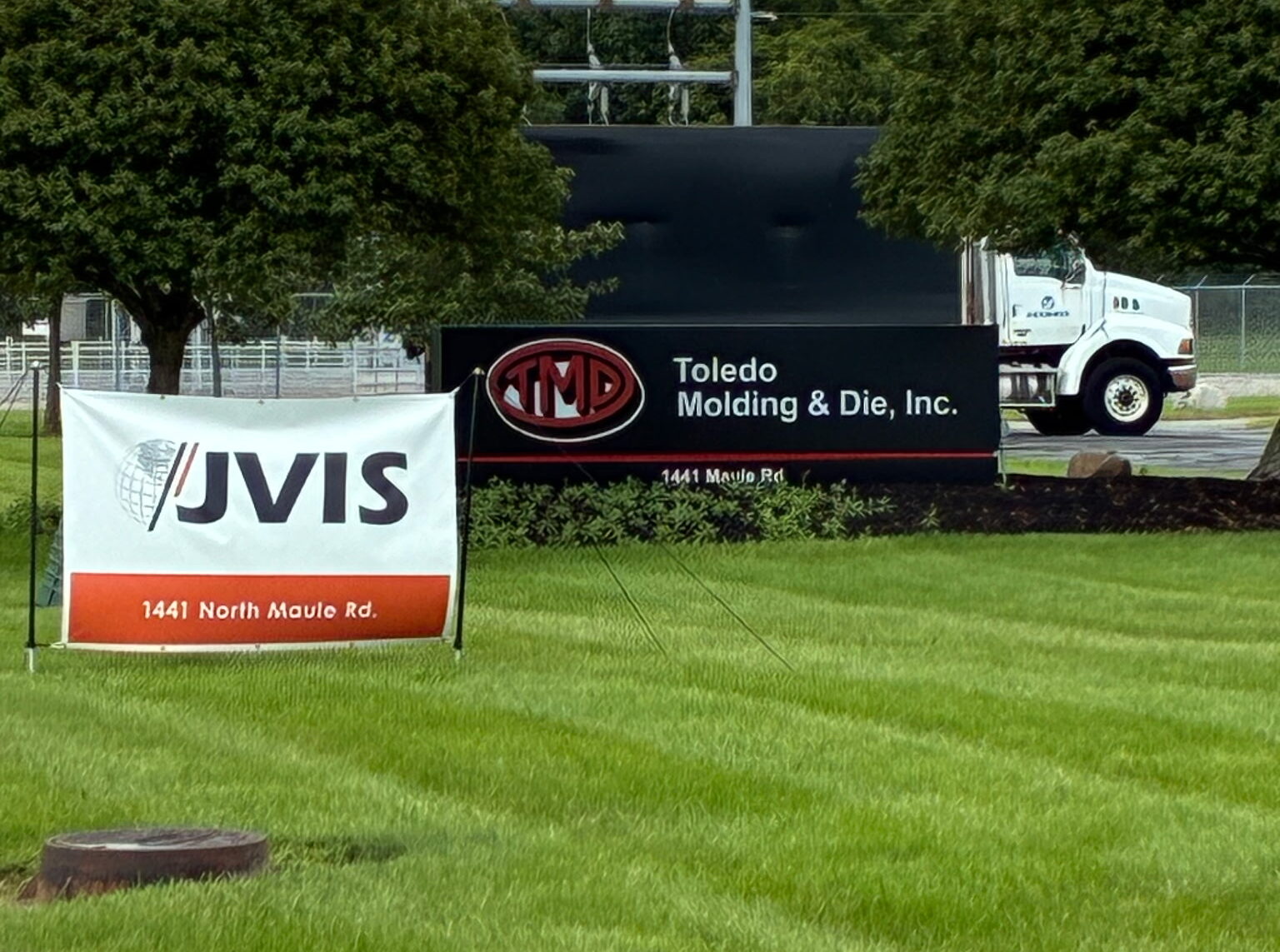
Featured image: A truck abandoned by the previous owners of the plant has been decaying in the Toledo Molding & Die parking lot since. Credit: Mike Davis.
It’s 5 PM in Ohio, the temperature is still hovering in the 90s, and Journeyman maintenance technician Mike Davis is winding down after a shift at the Toledo Molding & Die plant, where he’s worked for the past 13 years.
When I spoke with him, he was getting drinks with a few friends from the plant. They were sending off a contract technician who had just finished his last day on the job.
I asked if there is any animosity between the contract and the union technicians, but Mike told me, “I think that’s an unwritten rule with maintenance union guys. Once the contractors come in, you gotta give them dirty looks and treat them like shit… but he’s such a nice guy, I can’t. I just can’t hate him. Plus they’re here to help us, and we really need the help.”
They need the help because the Toledo Molding & Die plant has had a hard time keeping experienced maintenance technicians on staff, and many of the techs that Mike worked with over the years have moved on to better paying, non-union jobs at nearby plants. This has made it difficult for the remaining techs to do their jobs.
“A typical day for me anymore is going into a dumpster fire, and then leaving with it somewhat extinguished, knowing the next day when I come back in, it’s gonna be a dumpster fire again.”
As someone who assumed that a union job was the gold-standard in manufacturing, I was surprised that other plants were so easily outcompeting the appeal of a UAW contract.
“There’s thousands of factories up and down I-75,” Mike explained, “so when the [UAW] work conditions or wages don’t keep up, there’s really no loyalty.”
I value being a UAW member and I really do believe that the UAW can be a good fighting force and that we really can make a difference in the world.
But despite his frustrations at work, Mike isn’t eager to follow his friends and coworkers to other factories. “If I had a lick of sense, I think that I probably would have taken another job, especially when everybody else bailed out, but I value being a UAW member and I really do believe that the UAW can be a good fighting force and that we really can make a difference in the world.”
When asked if he thought there was potential for those other nearby factories to become unionized, Mike was hopeful. “I think so, because they’re at-will employees, and they’re in unsafe work conditions, and they’re getting hurt on the job, and they’re getting fired because of those injuries that they got on the job. And I think, yeah, wages is a hard thing to […] go against, but our benefits and our work conditions are two more important things […]. In my experience there’s very little interest in small organizing drives.”
This belief, that plants in the Independents, Parts, and Suppliers (IPS) sector and other small shops are “the unwanted stepchildren of the UAW” is something that I’ve often heard repeated by people throughout the UAW, and Mike is not the first to share this perspective with Daily Struggle.
I asked Mike to explain. “We’re caught as IPS shops in what’s known as the big squeeze. On one end, you’ve got the Big Three demanding our bosses cut costs on each job year after year, and it’s typically about 3% cost savings they want to see every year. And then from the other end, you have the union demanding higher and higher wages for the workers at the Big Three. So, you’ve got the IPS shop in the center, and it feels like… we’re on our own a lot, you know? They’re going after pensions for the Big Three in 2028 and like… that is great for them, but how does that affect us as IPS workers? How does that benefit me as an IPS worker, being laid off of work for months because the Big Three goes out on strike and losing out on income for months so that the Big Three can get all of their pensions back. Cause I’m sure the fuck never gonna see a pension.”
“I went from feeling like I can do this on my own, and I don’t need a union, and all they’re doing is taking my dues, to realizing that, holy fuck, I couldn’t handle that on my own, they took care of it for me, and I want to be that guy that takes care of shit for other people, you know?”
But despite all of his very valid complaints, Mike knows there is power in a union. “All it took for me was one bad boss to understand how important a union is. Before that, I would get write-ups, and they’d ask me if I wanted a steward, and I would tell them, no, I don’t need one. I can speak for myself. I don’t need anybody in there for me, you know? But once I had that boss, and I realized how dead set he was to get rid of me, that’s when I had no other choice than to reach out to a union. And actually, the union rep reached out to me. He walked up, and he’s like, ‘Hey, Mike, I see this guy treating you like shit… is there anything we can do to help you?’ And I explained to them the situation. And our chairman at the time got that guy pulled into a meeting and got that guy in trouble, and that right there showed me the power that they actually had to stop harassment like that, you know?
“I went from feeling like I can do this on my own, and I don’t need a union, and all they’re doing is taking my dues, to realizing that, holy fuck, I couldn’t handle that on my own, they took care of it for me, and I want to be that guy that takes care of shit for other people, you know?”
And throughout everything, Mike has felt real solidarity with his coworkers.
Mike shared how when management laid off his plant during the Big Three strike, “the Community Services Committee built a strike pantry. And we were able to give away food packages, and help each other out when we were going on unemployment.”
As our call came to an end, I wanted to know what Mike, someone who is both very loyal to and incredibly frustrated with our mighty, mighty UAW, would say if he could sit down with the International leadership.
“I would tell them that they need to be more on the militant side, and that they need to quit trying to be a part of the system that is obviously corrupt and evil. And I think that when we’re dealing with a corrupt system right now, the only way to do it is by being militant, and taking actions that they’re gonna call illegal. Because they’ve written the laws in a way to rig the system in their favor.
“One of the most disappointing things that I have with our current IEB, is that they aren’t militant. And we could use our power as a membership to really make change in this country. But until they have a set of balls big enough to stand up and fight back against that, none of us UAW members are even gonna think that’s an option.
“Like, they have to say, it’s our duty, not only as union members, but as American citizens, to fight back against a corrupt government. And we’ve got a corrupt government staring us right in front of our fucking eyes.
“I would tell them that I love the UAW for what it can be, not what it is right now.”