Breaking the Whipsaw: Sectoral Bargaining in Legal Services
The success of sectoral bargaining and strikes across UAW locals in legal services in New York City shows what workers stand to gain from sector-wide coordination and rank-and-file militancy.
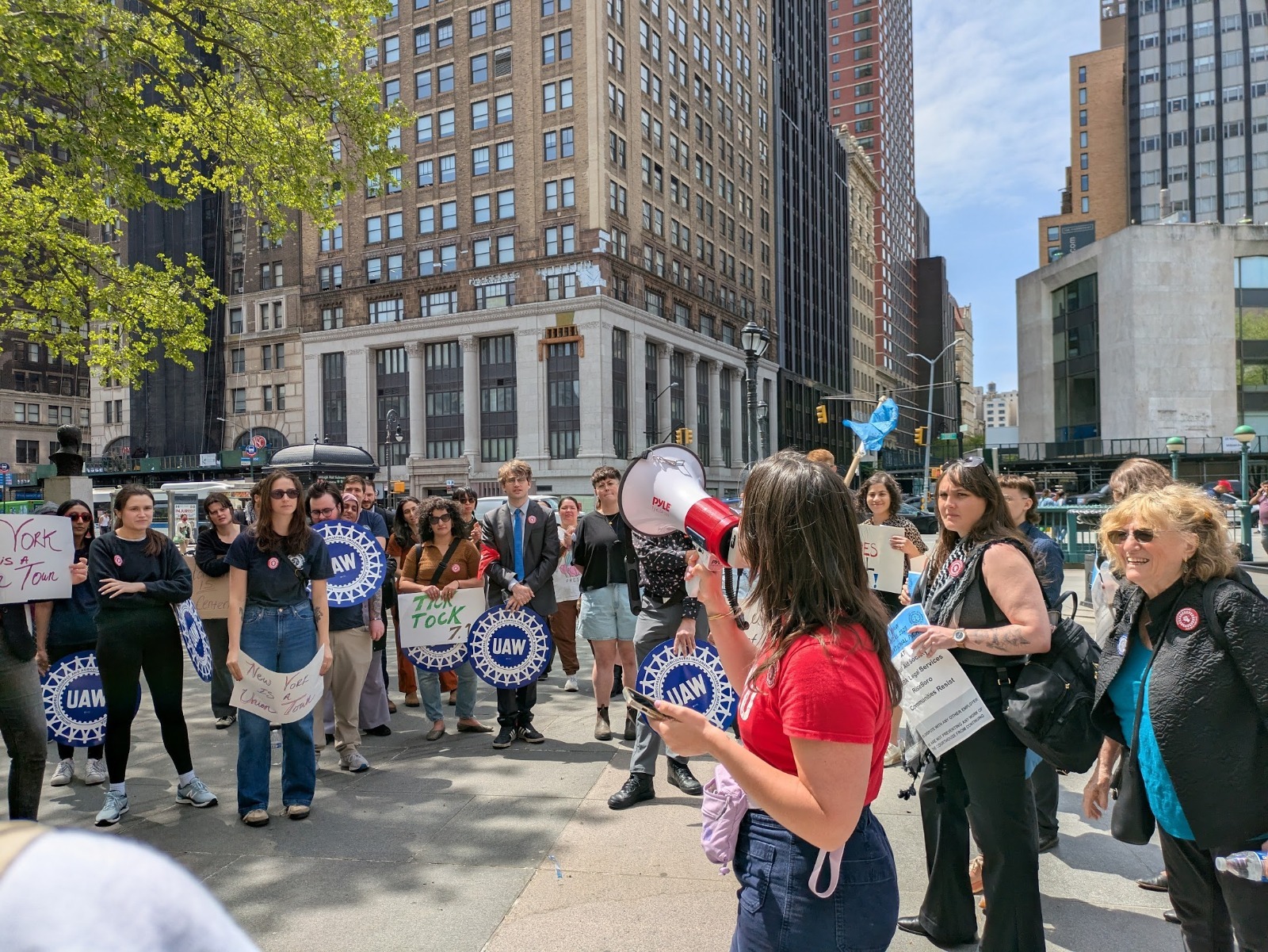
Featured image: Legal services workers rally after picketing Brooklyn courthouse, May 1, 2025. Credit: Navruz Baum.
This article is part of a series in our initial October 19, 2025 release of Daily Struggle. Read more in our introductory editorial, A Class Struggle Vision: Why UAWD is Launching Daily Struggle.
Listen to an audio recording of this article:
Whipsawing is one of the oldest and most effective tools that bosses have. Across auto, parts suppliers (IPS), and dozens of other sectors, the strategy is simple: divide workers into separate bargaining units and pit them against one another to drive down wages and conditions.
New York City’s legal services sector is no exception.
The sector was created in its modern form in the 1960s, in the chaotic, fast-paced conditions of the criminal legal system. Over the following decades, it grew as representation in civil, immigration, housing, and family courts expanded.
UAW Local 2325 members once all worked for the Legal Aid Society (LAS). But in the 1990s the City, which contracts LAS to provide constitutionally-mandated legal services, broke it up and instituted a competitive bidding model to pit workers against each other. The new, non-union organizations competed with LAS and with each other on “cost per case,” fueling a race to the bottom on wages and service quality. The explicit purpose, as admitted by then-mayor Rudy Giuliani, was to de‑unionize the sector and undercut the power of organized labor. Thirty years after that assault, workers finally turned the tables on the City through years of careful planning and organizing, culminating in united cross-shop bargaining and a wave of coordinated strikes across the sector.
The fight to restore worker power began in 2019, when Local 2325 launched a campaign to re‑unionize the legal services sector in New York City. Over the next several years, workers across organizations formed unions—tripling the local’s membership, rebuilding density, and reclaiming their power. Once union strength was restored, 2,000 workers across eleven shops aligned their contracts to expire together on July 1, 2025, laying the groundwork for a sector‑wide confrontation.
In June 2024, workers from across the sector gathered for a two-day convention where they fleshed out the details of sectoral coordination and shared demands. Each shop sent one delegate for every ten members, making it a broad, representative body. Delegates voted overwhelmingly for bold priorities: cost‑of‑living adjustments (COLA), a $70,000 wage floor, workload standards, pensions, and more. They also created new rank-and-file-led cross-shop structures to coordinate the campaign. The convention raised expectations across the sector and gave workers the structures to fight for what they truly needed, not settle for what management said was realistic.
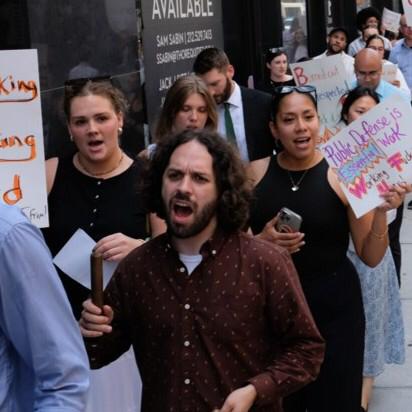
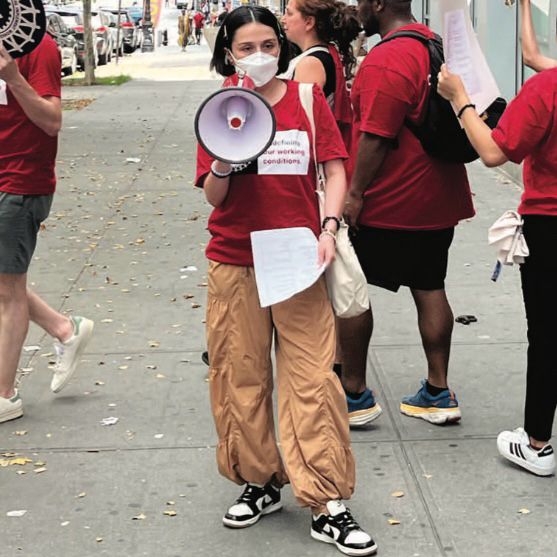
Over the following year, workers put these resolutions into practice, electing bargaining committees, building contract action teams, drafting demands, and assembling cross-shop coordinating bodies. Eventually, more than 750 workers across seven of the sectorally-aligned shops went on strike, with work stoppages lasting anywhere from a single day to over two months.
The campaign also built political support, securing endorsements from elected officials. In the 1990s, legal services workers—then unionized but not yet affiliated with the UAW—faced retaliation as the City canceled contracts and threatened to blacklist strikers. But this time, a more favorable local climate, UAW backing, and worker political organizing ensured that the City didn’t interfere.
These victories demonstrated that demands once dismissed as unrealistic could be achieved through collective action and sectoral unity.
The fight was not without contradictions. A significant minority of members wanted to strike at the Legal Aid Society, and to strike longer at NYLAG, despite recommendations from shop leadership to settle. Some decisions—such as striking at the Bronx Defenders, holding firm on wages and collapsing tiers at NYLAG, and picketing secondary locations like courthouses—were made by workers despite staff advice to compromise. These tensions demonstrate the conflicting viewpoints that can arise in any campaign, the importance of rank-and-file having real power, and the need for accountable, democratic structures to synthesize these tensions.
Campaign organization also fell short in some respects. Participation in the cross‑shop bodies was uneven. Demand coordination was strongest on wages but less consistent in other areas, leading to uneven results. These shortcomings highlight the need to build more capacity to carry sectoral campaigns further.
The campaign’s largest limitation was simply that the project of sectoral integration is unfinished. While an unprecedented number of workers and shops took part in this round of sectoral bargaining, some significant shops, such as Brooklyn Defender Services and Neighborhood Defender Service, weren’t aligned. There’s also a legacy of craft-model unionism in the sector’s largest shop, the Legal Aid Society, where over 500 support staff are in a different union than the attorneys. This structure severely limited coordination and highlighted the complexity of fully integrating the sector.
But the results show that rank‑and‑file militancy delivers. Workers won and improved workload standards. They created their first ever cross-shop student loan reimbursement fund, providing immediate material relief as well as a template for future multi-employer benefits to tie together the sector. They won improved parental leave and new free speech protections. But the most dramatic achievement was the leap in wage floors. Before the campaign, the wage floor at sectoral shops ranged from $46,969 to $57,342. After the campaign, the lowest wage floor at a sectoral shop was $55,000, while workers at the Bronx Defenders won a $68,500 floor. As a result of these gains, the lowest paid workers saw raises of up to $15,000 (30%). These victories demonstrated that demands once dismissed as unrealistic could be achieved through collective action and sectoral unity.
Sectoral bargaining by itself does not guarantee militant tactics and better contracts. In New York’s legal services sector, rank‑and‑file democracy made a crucial difference. Delegates at the convention set bold demands. Workers on bargaining committees voted to strike and reject concessions. Members in cross‑shop bodies chose militancy and coordinated strategy. The result was higher wage floors, better benefits, new protections for workloads and speech, and a sector united against whipsawing.
What worked in legal services this summer echoes the lessons of the rise of industrial unions like the UAW in the 1930s. When the UAW was born, autoworkers rejected organizing along narrow job title and craft lines, knowing those divisions left them weak. They also understood they had to organize the entire sector—not just one company—to raise standards and build real power.
But since then, bosses have successfully rolled back this model, not only in legal services but in sectors across our economy. In higher education, graduate student workers often bargain separately from adjunct professors, support staff, and other titles. Workers in IPS, heavy truck, and agricultural implement sectors labor under atomized contracts: coworkers at factories down the street—and even in the same facility—operate under completely different contracts, or have no union at all.
By building rank-and-file unity across organizations, rejecting the logic of competition, and treating the fight for one contract as the fight for all, workers in legal services and other sectors have revived the very principle that built the UAW in the first place—and that still defines class struggle unionism today.
UAW Local and International leaders have done little to challenge this fragmentation, maintaining a status quo in which disconnected rank-and-file members struggle to coordinate or build bottom-up movements. Yet moments like the 2021 Deere strike—when workers organized across plants and states to reject a weak contract and win more—show flashes of the power that exists when workers break through those divisions.
Workers in legal services and other sectors are rediscovering that same power. By building rank-and-file unity across organizations, rejecting the logic of competition, and treating the fight for one contract as the fight for all, they have revived the very principle that built the UAW in the first place—and that still defines class struggle unionism today. Workers in legal services, auto, IPS, higher ed, and every other sector will have to carry these lessons forward if we’re going to win not just better contracts, but a better world.