
Overcoming Rural Worker Exploitation: Building a Militant Sectoral Manufacturing Strategy
As the rural working class is being exploited for profit through predatory tactics that decimate rural communities, some rural workers have built rank-and-file power to mount militant strikes that span rural facilities across the country. A class struggle vision would move beyond simply organizing new shops and narrowly fighting for bread-and-butter issues, expanding demands to fight whipsawing and address brutal workplace conditions by giving workers more control over the shop floor.
Featured Image Credit: Allie Stanton.
The working class—workers everywhere, whose labor makes the world go round, who hit that clock every day and grind it out—are all locked into the same system of oppression. The billionaires and corporate overlords are the biggest bullies in the world and have waged an all out war against the working class, exploiting the labor of workers across industries, sectors, and geographic regions. We have no choice but to struggle against our oppressors together.
The working class has the power to create extraordinary change, but only if we start working together as one class. We have so much to learn from each other, so many successful strategies that workers have used to fight back against the boss. As manufacturing workers, we know our employers build facilities in both urban and rural areas as yet another way to pit us against each other and hedge against different economic and demographic conditions. To build our collective strength, something that we should give more consideration to is how we can overcome the unique ways that bosses exploit rural workers.
The differences between industrial manufacturing in urban and rural areas are glaring. When the capitalist class builds plants across rural parts of the Midwest and vast swathes of the Deep South, as it has done increasingly, it operates under less favorable conditions. Underdeveloped infrastructure, smaller labor pools, and reduced access to parts suppliers, all harm the bottom line of any company. Given these impediments, what actually draws manufacturing corporations to rural communities? Why would they invest billions of dollars to develop facilities in isolated areas rather than in more industrialized, commercially developed urban regions?
The answer comes from analyzing the specific ways that the capitalist class has exploited the working class in rural settings. With poor infrastructure and supply chain logistics, capitalists have championed a predatory approach to extract their profits, designed to ramp up the exploitation of vulnerable workers and communities in small-town U.S.A.
Corporate “Opportunity,” Local Consequences
Corporate managers of manufacturing plants wield enormous power with local politicians in small communities. These bosses broker deals for lucrative tax incentives in exchange for job creation and have zero qualms about making false promises.
Often portrayed as some sort of “heaven-sent job providers,” these corporations are ushered in with open arms by vulnerable communities struggling to combat rural economic despair. But instead of bringing lasting, economic prosperity for communities, predatory bosses employ a business model designed to extract nearly all of the wealth that rural workers produce.
After milking the community for tax incentives and exploiting workers to the bone, these corporate overlords have no concerns about cutting and running, leaving broken communities like Belvidere in their wake.
The aftermath of this “corporate investment” is often devastation, resulting in crippling hardship in rural communities for years to come. When conditions change, bosses shutter once-profitable facilities to cut losses, like the 2022 closure of Stellantis’ Jeep Cherokee facility in Belvidere, Illinois. Stellantis shuttered the Belvidere plant despite taking almost $18 billion in profit that year. After milking the community for tax incentives and exploiting workers to the bone, these corporate overlords have no concerns about cutting and running, leaving broken communities like Belvidere in their wake.
Then there’s the notorious tactic of whipsawing: pitting workers at different factories against one another with threats of closing plants, moving jobs, or withholding future product investment. Corporations are well-versed in this tactic for sowing dissension in order to get workers to accept less, driving down pay and work standards. After using fear to fuel a race to the bottom, bosses will often still slate one of the competing plants for layoffs, forcing workers to make the impossible choice either to hit the unemployment line or to move across the country and leave their family behind.

Weaponizing uncertainty allows companies to foster a culture of fear and timidity in the workplace, undermining worker militancy. Local and state politicians inevitably succumb to the heavy influence and intimidation of corporate lobbyists, who perpetuate anti-labor legislation, like right-to-work laws, that workers in retreat are too scared to fight. Militant unions, instead of accepting whipsawing and capitulating, should put in resources to bind workers together across rural areas and build solidarity—but for far too long union bureaucrats have taken the easy way out by accepting major concessions that they framed as saving jobs.
Exploiting Rural Workers with Few Other Options
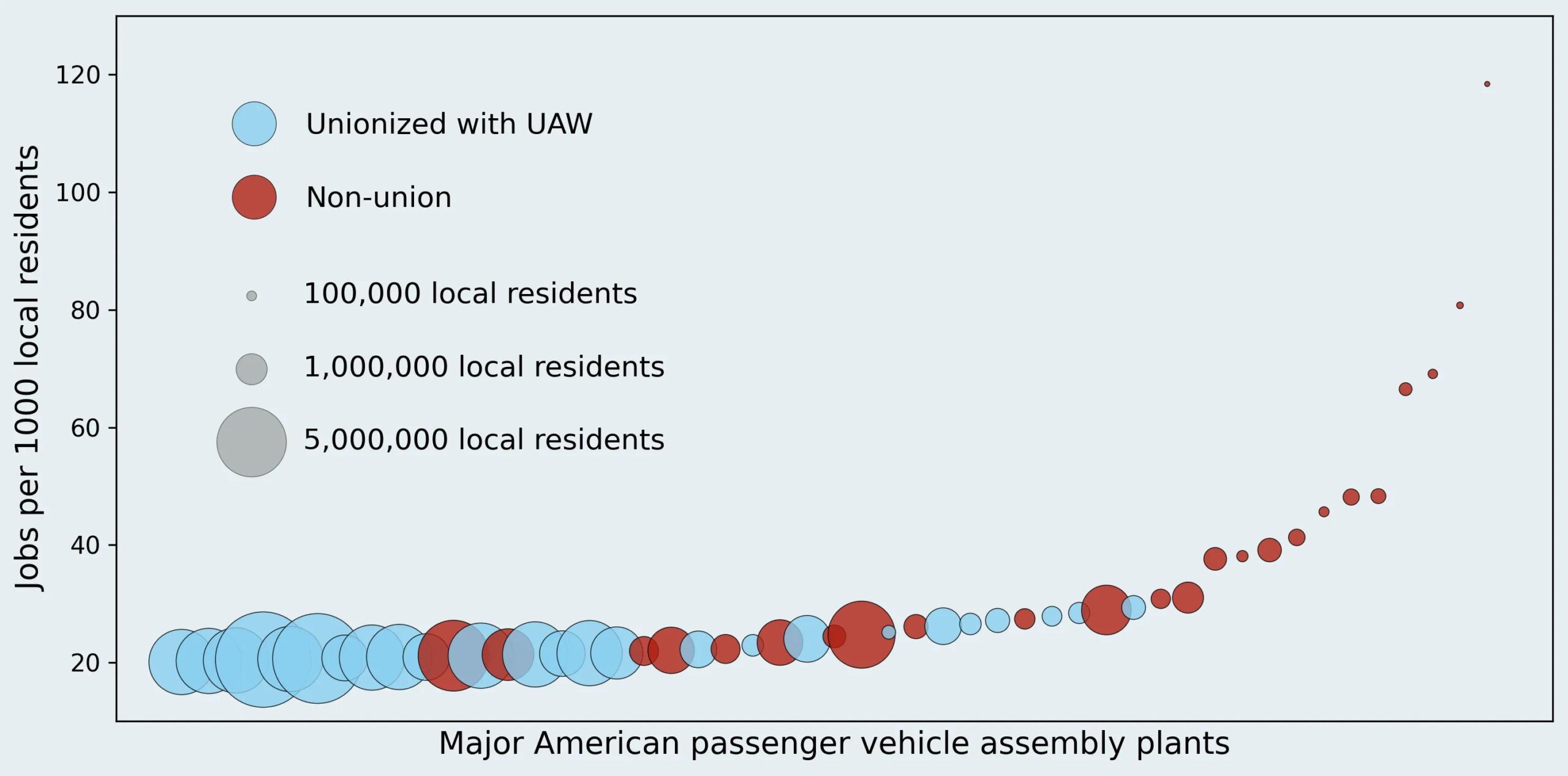
Rural workers have fewer options than urban workers for finding good paying jobs in their communities. The plot below shows that, across 49 passenger vehicle assembly plants in the U.S., plants in less populated regions dominate the local hiring pool, giving bosses more power in rural communities.
While scarce, factory jobs are also often the best paying in rural areas because international corporations have the biggest coffers, and, as a result, corporations know that they have leverage over workers who can’t easily access similar pay elsewhere. This tension forces workers into an agonizing decision: accept their oppressive conditions while dealing with arrogant and inept management, or accept less pay from the few options scattered within a hundred miles of their homes.
This dilemma creates an endless cycle for many workers, who may initially view other industries as an appealing option when they become frustrated with their overextended and hostile workplace, only to find that they can’t escape the oppression of the capitalist system no matter where they go. When most workers in non-union shops simply don’t see their coworkers as allies in a bigger struggle, they also don’t realize the power that they would have if they organized together to improve their workplace. Instead, when they become overwhelmed and frustrated, they leave for a worse-paying job in a less stressful environment, dissolving any cohesion that had been built among coworkers. The wheel comes full circle when financial pressure leads workers back to the better-paying plants with the dismal conditions they were trying to escape from.
Empowering Workers to Make Use of Their Leverage
Low rural density doesn’t just limit the options of workers—it also limits the options of management, who are dependent on local labor when seeking new workers to exploit. Although companies may talk big, their quotas and bonuses are too reliant on consistent production numbers to weather a significant work stoppage. While bosses do their best to undermine conditions and bring in temporary workers, complex manufacturing processes continue to have a large portion of “non-skilled” work that, in fact, requires someone with years of experience, or would be done more effectively by an experienced worker.
During the heyday of the CIO in the 1930s, workers across major sectors, like auto and agricultural implements, were brought into the same unions, paving the way for the militancy and strike waves of the 1940s.
To take advantage of this leverage, union leaders need to give more attention and resources to developing sectoral agreements for manufacturing workers, which was once a dominant strategy in the labor movement. During the heyday of the CIO in the 1930s, workers across major sectors, like auto and agricultural implements, were brought into the same unions, paving the way for the militancy and strike waves of the 1940s.
Much more recently, in 2021, rank-and-file workers at John Deere, operating under a national agreement that encompasses over 10,000 workers spread across more than a dozen facilities, challenged the status quo. Knowing that they were fighting together for their own worth, they used their power to mount a militant strike. They had to beat back not only their bosses, but also their own union leadership, which was reluctant to wield rank-and-file leverage at the bargaining table. Workers voted down an initial lowball tentative agreement that was being pushed by union leaders, despite the lack of any substantive gains, and they stayed on strike, ultimately winning big.
Whether across multiple workplaces controlled by the same company or, better still, across a whole region and covering many companies, sectoral agreements serve two important roles in building rank-and-file power. First, they provide a concrete basis for combating whipsawing, by standardizing conditions and benefits so that bosses can’t plunge us into a race to the bottom with threats of moving work elsewhere. Sectoral agreements that span across rural regions are necessary to give workers a way to wield their own leverage in response to defeat whipsawing. Second, sectoral agreements tie workers together culturally, contractually, and organizationally, concretely forging a unified working class that is struggling together.
Even without support from union leaders, who often want to keep workers separated and under different contracts to maintain their control, rank-and-file leaders can take big steps towards building sectoral power by starting to develop shared community and organization. By communicating and strategizing as one unit, workers in different areas across the country can ensure that they coordinate to demand more and refuse to accept less.
Building a Militant, Class Struggle Sectoral Strategy, Beyond Simply Organizing New Shops
In 2024, as rank-and-file organizers at the Mercedes plant near Tuscaloosa were gearing up for the vote to join the UAW, Alabama Governor Kay Ivey denounced the UAW as an “out-of-state special interest group.” Of course, she didn’t tell her constituents about all of the outside money she had taken for her election campaign, but it didn’t matter—her scare tactics were effective. Her demonization of our union was reprehensible, a ploy to undermine working-class solidarity, but it proved effective because rural workers often don’t see themselves in the UAW’s campaigns to build new unions.
A class struggle unionization campaign would better be able to bridge political divides by expanding demands for workers to have more collective control over their working conditions, scheduling, and work-life balance.
To build new union campaigns that workers trust and feel connected to, we need to empower our rank-and-file organizers to speak honestly with their coworkers about material issues that impact the entire working class, which means going beyond narrow bread-and butter-issues. We need to commit to bargaining for more than pay and benefits, demands which are often used by management to claim that unions just want to take extra pay as a cut in the form of union dues.
A class struggle unionization campaign would better be able to bridge political divides by expanding demands for workers to have more collective control over their working conditions, scheduling, and work-life balance. This would include highlighting demands in new organizing campaigns like wide protections for halting work in unsafe conditions and regular shop floor worker meetings that have the power to shut down production in an area if health and safety standards aren’t being met. It would also include negotiating wage floors that prevent whipsawing and protect all workers, both in rural regions and around the world, from being exploited by the companies that profit from our labor.
Organizing rural, southern manufacturing plants is essential to building union density, but it alone isn’t enough to win what the working class desperately needs. To build a class struggle union, we need a comprehensive overhaul from the bottom up, with rank-and-file union workers tapping into the militancy that’s been lost and standing together. We need to get back to our roots, to renew the tradition of working-class militancy that’s been too long forgotten. We need to stop being scared of what the capitalist state calls “radical” and instead start actually being radical.
During a moment of economic downturn, as companies are looking to cut costs, rural and southern workers have an unprecedented opportunity to chart a course that will change the lives of the whole working class. Militant workers in rural America can come together to develop a radical class struggle vision for how to bring together union and non-union workers, centered on taking back control of our workplaces and our communities.