The UAWD Membership Votes Not to Endorse Any Candidates in the 2026 IEB Election
With ballots mailing this week for the UAW International Executive Board election, we share why the UAWD membership voted to not endorse any candidates at our meeting last week, despite running the campaign to elect Shawn Fain four years ago. We explain our assessment that Fain has been co-opted and re-entrenched the old-guard Administration Caucus, and why neither Fain nor any of his opponents have met the low and achievable bar put forward in our IEB Endorsee Program for building a militant UAW.
At our Summer Membership Meeting last week, the UAWD membership considered resolutions to endorse or not endorse candidates in the 2026 UAW IEB election. The UAWD membership ultimately voted to approve the following editorial, written by three members of our Steering Committee, taking a position not to endorse any candidates.
The membership of Unite All Workers for Democracy (UAWD) has voted to not endorse any candidates running in this year’s election for the UAW International Executive Board (IEB). We believe it is important that we explain why. In the 2022 election cycle, UAWD selected each of our IEB candidates through a democratic endorsement process, raised over $200,000 for our campaign, and mobilized hundreds of UAWD volunteers in support of our endorsed candidates. We are proud of the organizing that UAWD did four years ago to defeat Ray Curry and elect our UAW Members United Slate, led by President Shawn Fain—but the reality is that our slate was not capable of meaningfully undermining the rule of the old-guard Administration Caucus (AC) in the UAW. Fain has instead been co-opted as the more progressive face of the AC, re-entrenched his former antagonists, and been realigned as their new leader.
We have learned many lessons in the years since the last election. This spring UAWD adopted a new IEB Endorsee Program with clear political commitments. It had a low and achievable bar, based on basic ideas for building trade union militancy that Shawn Fain himself has spoken about, each a practice that the UAW IEB can concretely implement to build a class struggle union: educating to build militancy for shop-floor demands through mid-contract strikes, organizing to promote working-class solidarity through cross-border wage floors in UAW contracts, and building capacity for general strikes through education about strategies and enabling member deliberation. No IEB candidate has met the criteria we adopted or engaged in our endorsement process since we circulated our program to the candidates.
While none of the candidates has met the low bar of our IEB Endorsee Program, we can still evaluate how close they came, in order to help our fellow UAW members who are interested in building a more militant union understand the electoral terrain. Of the candidates for president, only two even engage in rhetoric of needing to build a working-class fight against the bosses: Shawn Fain, the incumbent with a mixed track record who has now been subsumed as the leader of the AC, and Will Lehman, who uses a clear language of class struggle but without any record of shop-floor militancy and is dragged down by a politics that puts his narrow sect over a vision of class struggle unionism.
As the incumbent and the candidate in the field with the largest following, Fain is the most important to evaluate. The UAWD membership voted to adopt the analysis that Shawn Fain has taken a progressive bureaucratic approach to his presidency. As we previously wrote, “Fain has turned away from class struggle unionism, failing to follow through on his refreshing shift toward militant rhetoric and his influential push to reinvigorate the idea of a mass general strike.” While Fain’s embrace of class-conscious language is an improvement from the pro-business language used by UAW leaders for decades, particularly compared to the past few presidents, Ray Curry, Rory Gamble, Gary Jones, and Dennis Williams, the Fain administration has taken limited actions that have largely fallen short of Fain’s words.
With Dickerson and Campbell as Fain’s top running mates, and given the dominant role of their faction … Fain is setting himself up to be fully replaced by an old-guard leader in the years to come, either through planned succession or by him being stabbed in the back.
One guiding question many ask is whether it is easier for shop-floor militants to organize in the UAW under Fain than under previous UAW presidents. Different workers in different workplaces and regions will answer that question differently, but, when it comes to the structure and shop-floor politics of the UAW, not much has changed. As we describe in our Fain analysis, “So far, for example, there is no evidence of union leadership undertaking any of the concrete preparations necessary to carry out a general strike or supporting UAW members to lead their own campaigns to organize Southern auto plants and to strike over mandatory overtime and layoffs. These shortfalls are examples of the overall pattern that we identify in the UAW under Fain’s leadership: a welcome shift toward renewed labor militancy and international working-class solidarity, but one that has so far remained largely verbal, while the UAW’s actions have failed to match, and in some cases have undermined, Fain’s stated commitments.”
A UAW president doesn’t govern independently—they’re tightly constrained by the staff of Solidarity House and the IEB members they sit in coalition with. Fain’s rhetoric offers promise, but he cannot be separated from his slate, and we must expect more from our union than what the United UAW Slate is offering. The slate is a warmed-over reconstitution of the Administration Caucus, with Shawn Fain at the top, LaShawn English and Brandon Mancilla sitting awkwardly in the mix, and 10 long-time AC members, including two of its most senior, repressive enforcers, Laura Dickerson and Brandon Campbell.
As we detail in our Fain analysis, Dickerson and Campbell led the effort to block Fain’s outreach to rank-and-file members during the run up to the Stand Up Strike and have been the chief antagonists to Fain’s appointees in Solidarity House, miring staff in minor scandals to undermine their work. During the Candidate Forum for Vice President, Dickerson repeated the same business-unionist talking points that have defined the AC for decades—for example, that leaders taking “command” of bargaining from the top down is what gets the goods. With Dickerson and Campbell as Fain’s top running mates, and given the dominant role of their faction—shown through their control of the events of the 39th Constitutional Convention and blocking the protection of One Member, One Vote—Fain is setting himself up to be fully replaced by an old-guard leader in the years to come, either through planned succession or by him being stabbed in the back.
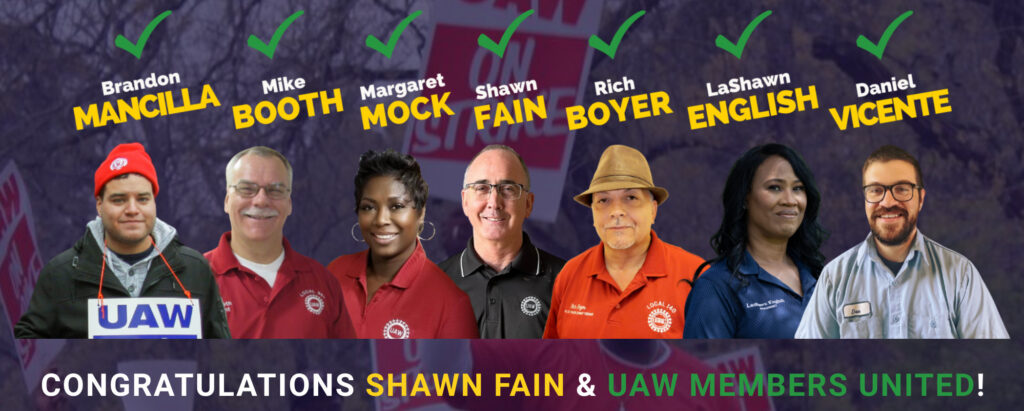
We know that slates matter. UAWD’s Members United Slate had many weaknesses. This was very quickly revealed by the actions of Rich Boyer, whom UAWD later voted to unendorse for his concessionary deal-making, and Margaret Mock, whom UAWD later voted to unendorse for undermining the Stand Up Strike and Southern organizing campaign. Fain has rightfully argued that he was unable to accomplish as much as he would have liked because he was weighed down by the poor performance and poor politics of his former slate on the IEB. Unfortunately, this appears unlikely to change with his new slatemates. While a union president can set a strategic direction, there’s little they can do to change conditions directly for workers on the shop floor. We have to look beyond rhetoric to the structures that remain in place. Fain has been ensnared and chosen to be subsumed as the leader of the AC, leaving the old guard, ever deep-rooted and intractable, in control. It is not a coalition we can endorse.
As we explain in our Fain analysis, while his rhetoric in support of Palestine and migrants has also been significant, Fain has balked at translating verbal commitments into any kind of consequential action—at least until UAWD forced the bureaucracy’s hand, winning the vote in June to divest from Israel bonds. The AC has a decades-old legacy of progressive business unionism, with Walter Reuther’s opposition to segregation and ultimately the Vietnam War and Bob King’s internationalist rhetoric and support for migrants at the Southern border. “But nothing changed in regard to the UAW bureaucracy’s engagement with the bosses or its approach to membership. In this light, Fain’s presidency can be seen as a more militant extension of King’s presidency, the progressive face of the Administration Caucus in the present political moment.”
Some UAW members have argued that class struggle unionists should endorse Fain because of the attacks he faces from the Department of Justice and the UAW Monitor, especially because the Monitor attacked Fain over the UAW’s position on Gaza. But far from having a principled opposition to the state interfering with our union, Fain long supported the Monitorship being imposed on the UAW. As recently as last month’s Candidate Forum for President, Fain bragged about how closely he worked with the Monitor prior to being attacked by him and how he continues to work well with the Monitor’s team. Fain said he “wouldn’t be here today as president if it weren’t for the Monitor.” Instead of being driven to endorse Fain because of these attacks, our role is vocally to support our union’s autonomy as a working-class institution and stand against the intervention of the state in our internal policy-setting and our democratic processes. We should oppose the state’s attacks against Fain like we would oppose attacks against any other member or leader of our union by making clear that it’s our role to hold leaders accountable and discipline them according to our own internal processes.
Some brief analysis on the other prominent candidates for UAW president: Rich Boyer’s lack of vision, poor performance, and track record of business unionism in his term as Vice President indicates that he would be incompetent in the role and, ultimately, fully reliant on the Administration Caucus staff of Solidarity House. Brian Keller’s parochial and Big Three-chauvinist vision is merely a version of Margaret Mock’s austerity unionism with more bluster and more explicit anti-solidaristic nationalism, and it would be executed with similar incompetence.
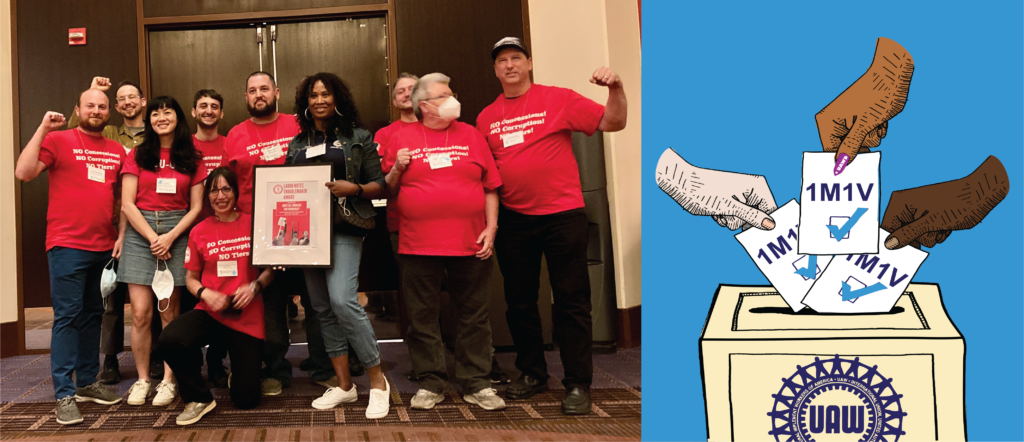
Ultimately, while UAWD is not endorsing any candidates in the 2026 IEB election, we remain proud of our role in leading the campaign to win One Member, One Vote, the right to directly elect top UAW leadership, and we encourage all UAW members to participate in this election. Watch the debates, learn about the candidates by reading their literature, and make sure you know the timeline for receiving your ballot, which should be arriving by the end of the month. Unlike government elections, which determine who leads the ruling class from a small pool of ruling-class candidates, union elections set our collective strategy. Even if none of the options before us today meet the low bar for building a militant UAW, maintaining control over our union’s leadership through democratic elections enables us to chart a course for class struggle in the future.
Featured Image Credit: Allie Stanton