Stellantis Shutters Canadian Plant and Promises Future Jobs in Illinois, UAW Leaders Cheer
Stellantis is shutting down its Brampton, Ontario, plant, devastating a Canadian community while saying it is sending jobs to the U.S. Instead of enabling Stellantis to execute on its whipsawing playbook, UAW leadership and U.S. autoworkers should unite with Unifor and Canadian autoworkers. Our union should be promoting a class struggle strategy of resisting plant closures by exerting control over production and building cross-border worker solidarity.
This article is published together with a case study examining the Stellantis Brampton plant closure. Follow our ongoing series of case studies of recent layoffs impacting thousands of UAW workers across auto and other manufacturing sectors, and submit a layoff report about your plant here.
The Brampton Assembly plant, near Toronto, has been idled and is threatened with permanent closure by Stellantis, impacting 3,000 workers.
The facility paused retooling from combustion to electric vehicles in early 2025, which Stellantis has implied was due to several factors, including electric vehicle (EV) market uncertainty and tariff pressure. In October 2025, amidst a major restructuring, the company effectively closed the plant. Stellantis announced that a combustion engine version of the Jeep Compass would be moving to the Belvidere Assembly Plant in Illinois, putting the fate of Brampton workers in limbo. As reported by The Pointer, workers found out their jobs were being moved to the U.S. through a surprise robocall just before Stellantis issued a press release stating that they would be investing $13 billion into U.S. production.
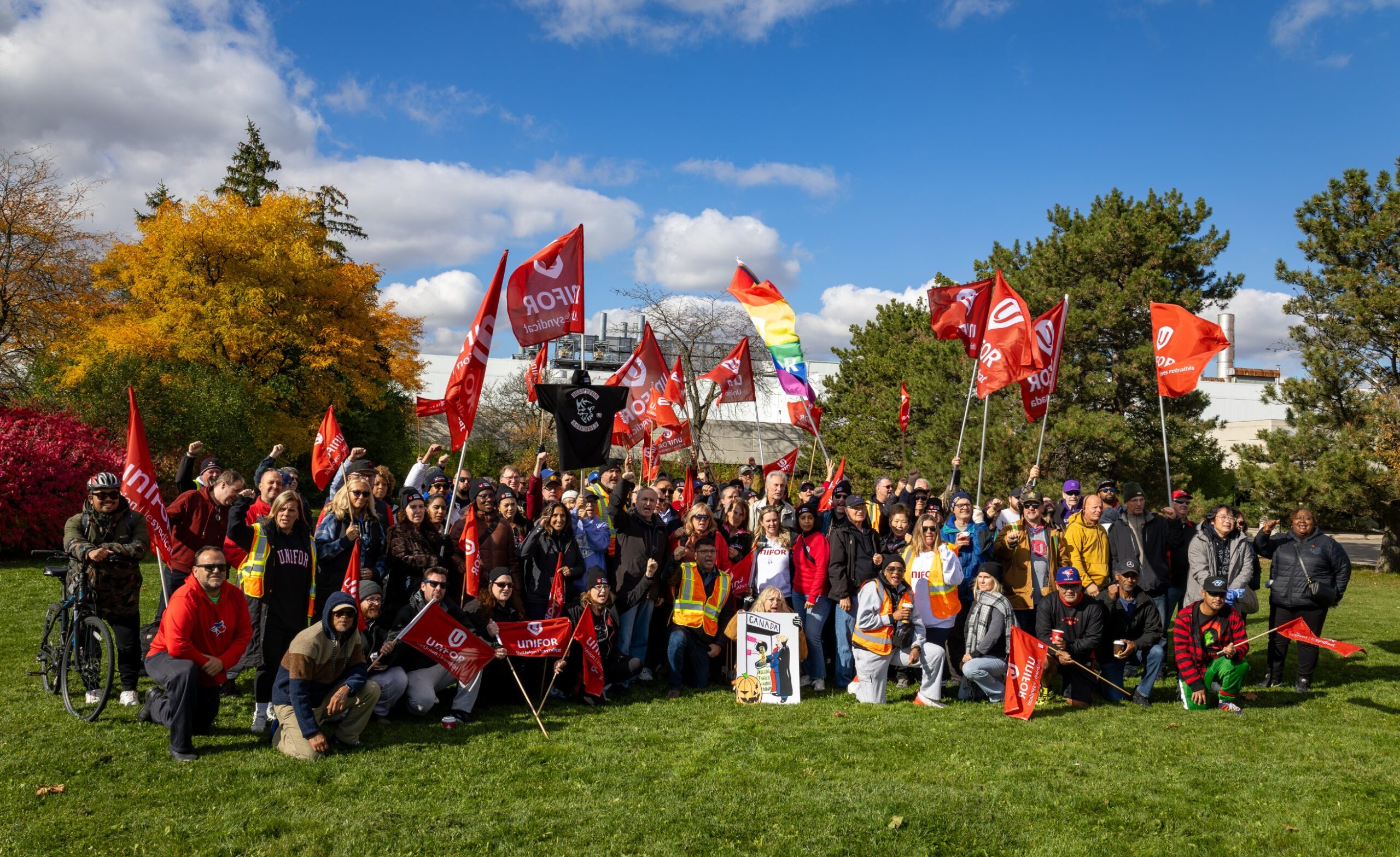
In response, the Canadian autoworkers union, Unifor, which represents Brampton workers, held a rally on October 29 to bring attention to the plant closure. Canadian General Motors workers rallied on the same day as their plant, CAMI Assembly in Ingersoll, was also facing effective closure, with management citing changing EV policies and the termination of the plant’s EV product as the cause.
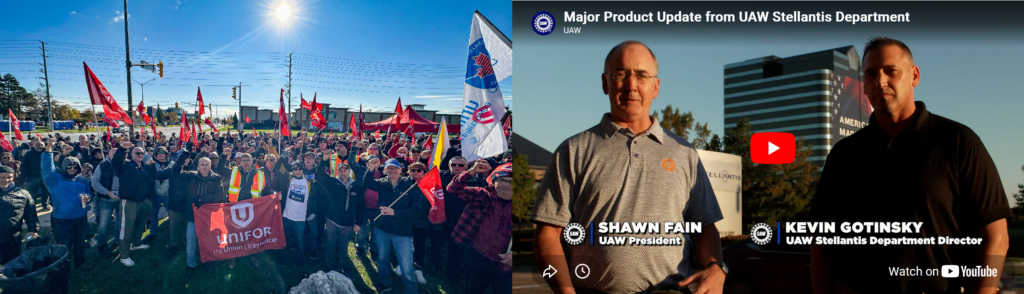
Earlier that month, in a UAW press release video, UAW President Shawn Fain and Stellantis Department Director Kevin Gotinsky celebrated. They bragged that pressure from the UAW and tariffs imposed by the Trump administration had resulted in “a major victory for UAW members and working-class people across the Midwest,” touting that Sellantis “will create 5,000 new UAW jobs over the next four years, with three new products.”
The press release makes no mention of the Brampton plant closure or the 3,000 Canadian workers impacted by it. While the company will likely never publish exact numbers, it is clear that many of the 5,000 “new” U.S. jobs at Stellantis are really just jobs lost by Canadian workers, with only some coming from modified product commitments that Stellantis had already made in the 2023 UAW-Stellantis National Agreement. It also remains uncertain whether Stellantis will even make good on the promise of 5,000 U.S. jobs: the commitment is for jobs associated with plants set to relaunch in 2027 or later, and the delays may mean that production does not begin until after the end of the UAW-Stellantis agreement in April 2028.
In March 2026, in response to Stellantis asserting that it is not planning on closing Brampton Assembly, Unifor Local 1285 President Vito Beato said, “We’ll take the positivity, but it’s just words. We need some meat and potatoes.” The plant remains without product as of the publication of this article, after Local 1285 rejected a proposal last month to build EVs from “complete knockdown kits,” which would bring very few jobs. Beato explained why that proposal wouldn’t work: “There would be no body shop. There would be no stamping facility. There would be no paint shop. There would be no welding. There would be no skilled trades. There would be no supplier base.”
Whipsawing playbook
For UAW members working at Stellantis, it may be tempting to celebrate what seems like a commitment of new jobs for U.S. autoworkers. But the idling and potential permanent closure of Brampton Assembly harms both Canadian and U.S. workers in the long run. What we are seeing is textbook cross-border whipsawing: the corporate tactic of pitting workers at different factories against one another with threats of closing plants, shifting production, and moving jobs in order to extract concessions and lower work standards.
Stellantis previously used the exact same tactic when it shut down Belvidere Assembly. First, the plant was idled in February 2023. Stellantis then used the possibility of re-opening the plant as a bargaining chip during the 2023 negotiations. UAW leadership claimed that they saved Belvidere when Stellantis agreed to re-open the plant as well as to build an EV battery plant and parts megahub. But shortly after ratification, Stellantis began to delay re-opening, which sparked the UAW to launch the Keep the Promise campaign. Presently, on paper Stellantis is still committed to re-opening Belvidere Assembly, but with an uncertain launch date, potentially after the 2028 contract expiration, while the Belvidere battery and parts plants are now cancelled, and Brampton Assembly is shuttered.
By not resisting this whipsawing, UAW and Unifor are ceding ground to the ruling class to set the terms and allowing Stellantis to pit U.S. and Canadian workers against each other. The UAW is perpetuating a race to the bottom that undercuts worker power in the long term, showing once again that corporations can extract concessions from workers by closing or threatening to close plants. The UAW has already demonstrated clearly that Stellantis will break the promises that it made just a few years ago. Why should we trust that their opportunistic claims about new jobs will be borne out now?
A class struggle approach
As Rob Lett and Nolan Tabb wrote in Daily Struggle, the aftermath of cycles of corporate “investment” followed by sudden disinvestment often produces staggering hardship for rural communities, such as Belvidere, Illinois, and Lordstown, Ohio. Stellantis, they observe, “shuttered the Belvidere plant despite taking almost $18 billion in profit that year. After milking the community for tax incentives and exploiting workers to the bone, these corporate overlords have no concerns about cutting and running, leaving broken communities like Belvidere in their wake.”
The UAW cheering as jobs move from Brampton to Belvidere can rightfully be seen by Canadian autoworkers as ignoring or even enabling the devastation that Stellantis is causing them. Instead of treating Stellantis like a shared enemy and banding together with Canadian autoworkers to stop the whipsawing, the UAW has taken a position that will undermine solidarity for years to come.
The bosses use tariffs, international trade policy, and EV market shifts as an excuse to cut jobs and undermine our unions. They make use of the shifting landscape not just to feed their need for short-run profits, but to ensure they can control their workers in the long run.
Workers should not have to suffer from auto companies’ boom-and-bust cycles. The bosses use tariffs, international trade policy, and EV market shifts as an excuse to cut jobs and undermine our unions. They make use of the shifting landscape not just to feed their need for short-run profits, but to ensure they can control their workers in the long run. To take control of our workplaces and livelihoods, we have to build up militant unions, with leaders and rank-and-file members who are ready to fight layoffs by contesting management’s unilateral control over production and employment levels.
The UAW should refuse to cheer Stellantis’s short-term promises and instead embrace a class struggle approach. This means rejecting a zero-sum perspective on North American auto jobs and building solidarity across borders—and oceans—to establish sectoral strategies based on equitable work sharing and fighting against plant closures. It can be done. It is up to us as workers to do it, by building militant shop-floor movements and transforming our union.
Layoffs at your plant? Report what’s happening and we’ll publish it to help workers understand changes to our industry.
Photo Credit: Unifor