Standing Down: Reflections on Shawn Fain’s Presidency
UAWD Steering Committee members present a deep dive into Shawn Fain’s presidency, through the lens of the pressures to deliver on the Stand Up Strike and the co-optive trap of bureaucracy. Fain has turned away from class struggle unionism, failing to follow through on his refreshing shift toward militant rhetoric and his influential push to reinvigorate the idea of a mass general strike. UAW members should understand Fain as the more progressive face of the old-guard Administration Caucus. Though he was elected to put an end to their stranglehold, Fain has instead re-entrenched his former antagonists and been realigned as their new leader.
The following editorial, assessing the approach taken by President Shawn Fain’s administration in the three years since he was elected, is based on a formal member-approved position adopted by the UAWD membership in May 2026.
In 2022, after leading the campaign for direct elections of the UAW’s top officers, which we won in an unprecedented referendum, Unite All Workers for Democracy (UAWD) assembled and led a slate for the UAW International Executive Board (IEB), sweeping all seven positions we contested and bringing President Shawn Fain into office.
Each of the authors, all current members of the UAWD Steering Committee, helped lead arms of the campaign to elect Fain in different parts of the country within four of the UAW’s primary industries: auto manufacturing, agricultural implements manufacturing, higher education, and legal services. We worked with Fain and his team after the election, and we watched as he pulled away from UAWD and into alignment with the UAW’s old-guard Administration Caucus, which has practiced a repressive, concessionary form of unionism for decades.
On the eve of next week’s 39th UAW Constitutional Convention, as Fain is set to be nominated for re-election to a possible second term as UAW president, we provide our assessment of the his administration: Fain has charted what we would call a progressive bureaucratic approach, described in the sections below, rather than advancing a program of class struggle unionism that sees organizing workers, across plants and sectors, as an independent class whose interests are fundamentally opposed to those of the capitalist class that live off of the exploitation of our labor. This approach would ultimately aim to take collective control of the production process itself, so that we would democratically exercise full decision-making powers over our work and lives. Instead of taking the kinds of risks that would advance a class struggle vision and empower rank-and-file members to work outside of the UAW’s typical staff-led organizing and bargaining model, which as we assess below would have endangered his position in Solidarity House, Fain has in effect become the new leader of the Administration Caucus, culminating in his running for re-election on an IEB slate dominated by his former antagonists in the old guard.
Fain’s embrace of militant and class-conscious rhetoric has nevertheless been a dramatic and refreshing shift away from the pro-business language used by UAW leaders for decades. The Fain administration also deserves credit for reinvigorating the idea of a contract campaign and of a mass general strike, something that hasn’t happened in this country for almost a century. This language and his early, if limited, rhetorical support for the Palestinian people have meaningfully helped advance the need for class struggle ideas to grow within the broader labor movement.
However, the Fain administration has failed to act in a way consistent with his verbal commitments, settling for some significant improvements to key UAW contracts but, otherwise, taking limited actions that have largely fallen short of Fain’s words. So far, for example, there is no evidence of union leadership undertaking any of the concrete preparations necessary to carry out a general strike or supporting UAW members to lead their own campaigns to organize Southern auto plants and to strike over mandatory overtime and layoffs. These shortfalls are examples of the overall pattern that we identify in the UAW under Fain’s leadership: a welcome shift toward renewed labor militancy and international working-class solidarity, but one that has so far remained largely verbal, while the UAW’s actions have failed to match, and in some cases have undermined, Fain’s stated commitments.
Below we make our case in four parts: First, we describe the opportunity Fain had to use the Stand Up Strike to engage the UAW rank and file directly and the way the Administration Caucus blocked him and forced him to choose between battling the staff or capitulating. Second, we review the historical role of the Administration Caucus, governing the UAW top-down, even when it sometimes had a progressive face, and how it used its control over the bureaucracy to co-opt Fain and ultimately realign him as its new leader. Third, we lay out how examples of how Fain’s move back into the bureaucracy has blunted his militant rhetoric, ranging from the general strike to organizing in the South, and to Palestine, and meant he has not taken action to back up his words. Fourth, we explain the broader significance of Fain’s move away from a class struggle approach and its key outcome in the broader political arena: a continuation of the UAW’s decades of aligning with the Democrats and catering to the ruling class.
Finally, we conclude with our assessment: our coworkers aren’t apathetic, they’re ready to fight, but they need the tools and the confidence to organize with their coworkers. The role of class struggle unionists is not to focus on reforming the bureaucracy, it’s to invest in the rank and file and entrust the UAW membership to take charge of their own struggle.
The Stand Up Strike, and the missed opportunity to transform the UAW
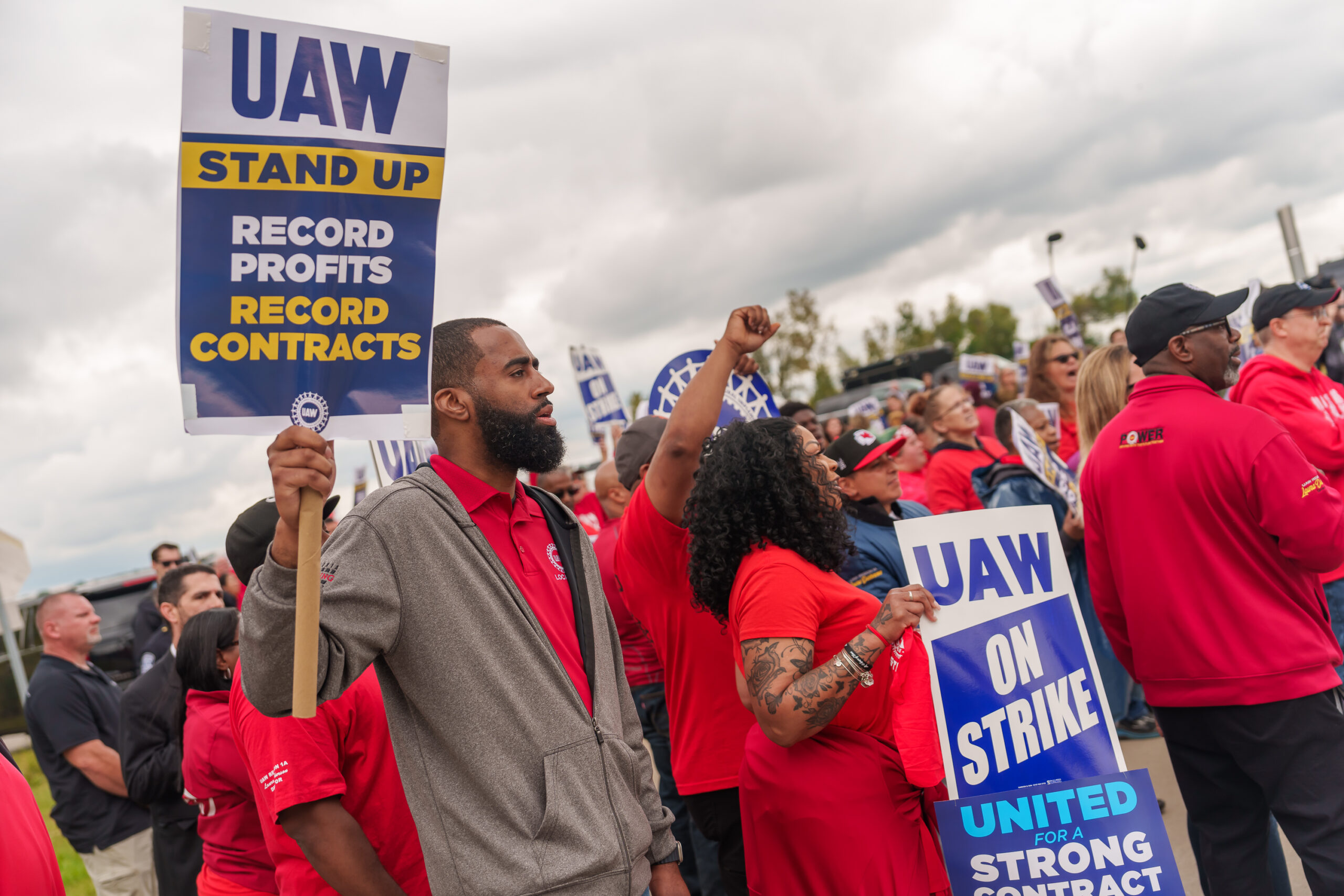
The 2023 Stand Up Strike may have seemed like it was just the beginning of Fain’s experiment in building a militant UAW, but it’s now clear that it was a missed opportunity to engage the rank and file directly. Heading into the strike, while the membership was preparing to fight, Fain had a unique chance to loudly proclaim the need to overcome the constraints on rank-and-file initiative imposed by the UAW bureaucracy.
While even he may not have realized it, to unbridle the union Fain would have had to go to war with the Administration Caucus, who made clear that they would never allow top leadership to directly organize member action, much less enable rank-and-file members to coordinate their own activity and collectively build confidence and militancy. Doing so would have required taking risks like touring the country, allocating funds directly to rank-and-file members locally to develop practice pickets when Local leaders refused, and speaking with members at large assemblies to encourage deliberation on, and even developing referenda for, strike priorities and strategy. But in the face of a fight with the old guard, Fain picked appeasement instead of conflict, allying with the bureaucracy instead of opening up rank-and-file participation, and that decision has defined the rest of his presidency.
Fain deserves credit for using the Stand Up Strike to introduce the idea of a contract campaign to many members for the first time. He started with a novel approach: bargaining simultaneously with all of the Big Three automakers, striking individual plants at each company each week if there wasn’t movement from management at the table, and transparently communicating with members by way of regular livestream bargaining updates. But there were signs early on that the campaign would function much like they had for decades and take a turn away from this more militant direction.
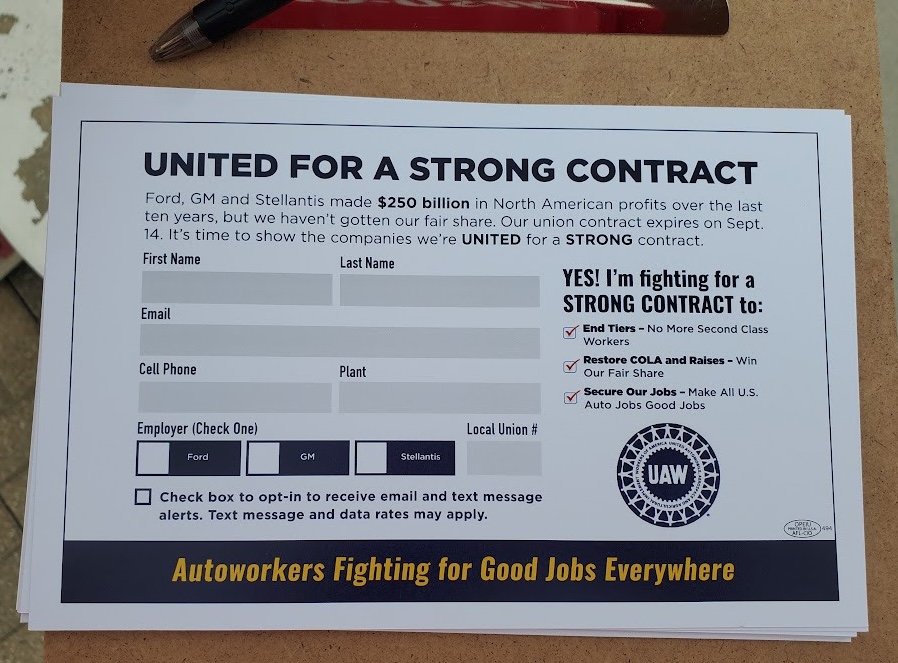
Months before the strike began, the Fain administration created a “contract campaign card,” which was circulated by Solidarity House to regional offices across the country to educate members about the possibilities of big wins during bargaining and collect the contact information of members interested in organizing for escalation. While these cards lacked specifics and fell short of meaningfully engaging the rank and file in a deliberation about what demands to prioritize and what kind of strike strategy they would support, they represented a substantial step beyond the absence of organization and the information blackout that had been characteristic of Administration Caucus bargaining.
Leaders of the Administration Caucus promptly refused to distribute the contract campaign cards at their shops, consistent with their long history of undermining UAW militancy. The effort to block the cards was led by two Regional Directors, Laura Dickerson and Brandon Campbell, who now sit with Fain atop his re-election slate. Multiple rank-and-file members have described seeing boxes of the cards sitting in their regional offices, as Dickerson and Campbell openly declared that they wouldn’t give them to local leaders or rank-and-file members, refusing to break with the decades-old UAW norm of not letting Solidarity House engage members directly. If Fain challenged them at all, it was never done publicly. He never went on Facebook Live to call on members to flood their offices to demand their contract campaign cards, and he never shared a version of the card that members themselves could print, distribute, collect, and hand back in to Solidarity House—both ideas suggested by UAWD leaders. This was the first public challenge from the Administration Caucus that Fain failed to meet.
Fain also deserves credit for popularizing important bargaining demands, especially relating to work-life balance and reversing the major concessions that the UAW made in 2008, in order to end tiers and restore pensions and healthcare for retirees. The demand for a 32-hour work week, however, was dropped without explanation before the strike even began, replaced with a weaker call for “more paid time off to be with families.” A 32-hour work week had been seen by many as a reach but had also rallied a new level of engagement from rank-and-file members who had been forced into long stretches of mandatory overtime. But building power and the rank-and-file capacity to organize and take risks to win these big demands was never going to happen with the bureaucracy actively sowing doubt and lowering expectations. If Fain wanted to avoid picking a major fight with the old guard, then he had to drop demands that they deemed “unreasonable.”
While the strategy of only striking certain new plants each week if companies failed to move at the table was hailed early on, a growing layer of rank-and-file members soured on the approach, as striking members felt that they were on their own and working members felt like they weren’t supporting the cause. Members at plants that had been struck in the earliest weeks lamented feeling like the weight of the strike was on their shoulders.
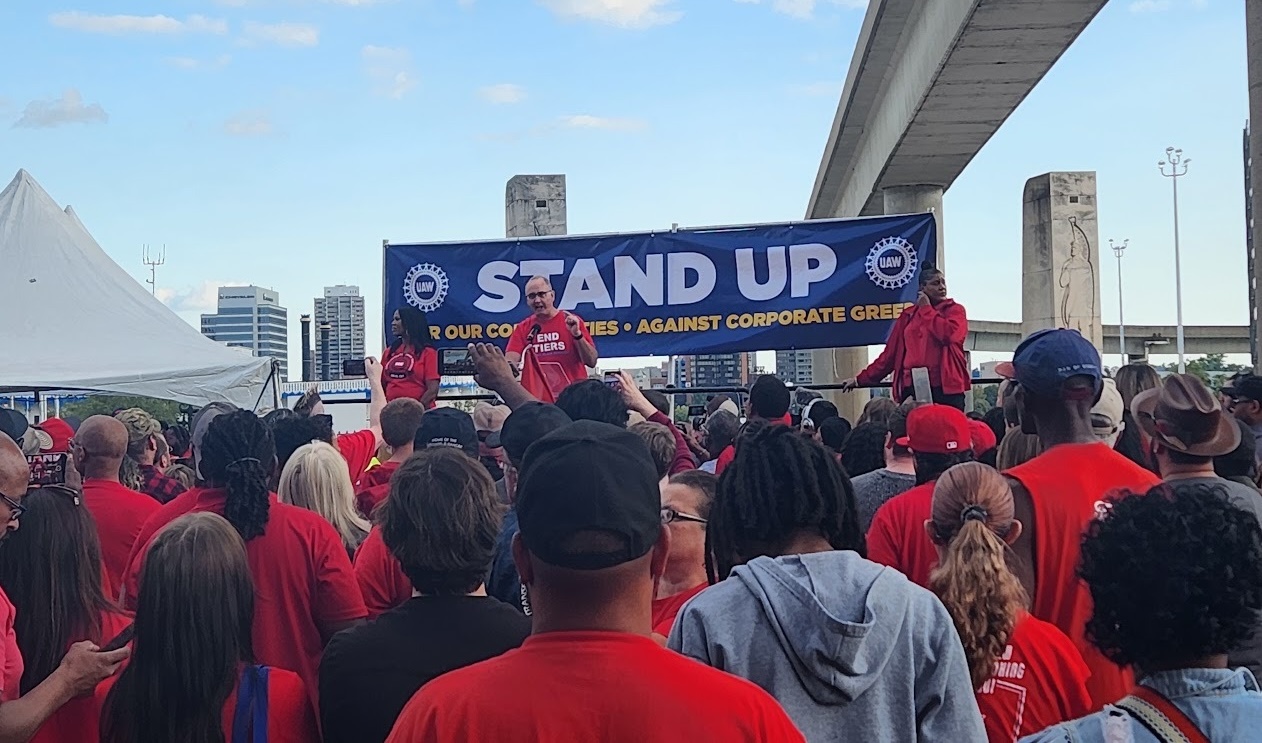
As bargaining got down to brass tacks, leadership decided to give up the key demands of restoring pensions and retirement healthcare. These were demands that everyone knew were unreachable without a long strike that inflicted serious pain on the Big Three, but for a broad layer of younger second-tier workers they were central to the whole purpose of the strike. Instead of unilaterally ending the escalation, Fain had a chance to let members deliberate and make the case for the importance of these demands. He could even have called for a mass referendum on whether to escalate to an all-out strike for pensions, encouraging members to engage each other about what it would mean, and in the process built trust with their coworkers—another missed opportunity.
The transparent communication that Fain had been hailed for in the run-up to and at the beginning of the strike became vaguer and less reliable in the final weeks. Ultimately, the Fain administration chose to put forward a set of tentative agreements in much the same way that the Administration Caucus has done for decades: suddenly and without communicating a clear understanding of what had shifted to justify the settlement. The mixed results of the ratification votes that followed reflected the ambivalence among members about whether they had used their strike power to the fullest—at both Ford and Stellantis, 69 percent of members voted in favor, while at GM only 55 percent of members voted to ratify their TAs. And in the years since the ratifications, rank-and-file sentiment has grown even less supportive, reflecting the reality that, on the shop floor, the working conditions haven’t gotten better.
The Stand Up Strike was a moment when Fain could have made a lasting break with the Administration Caucus rather than move closer to it.
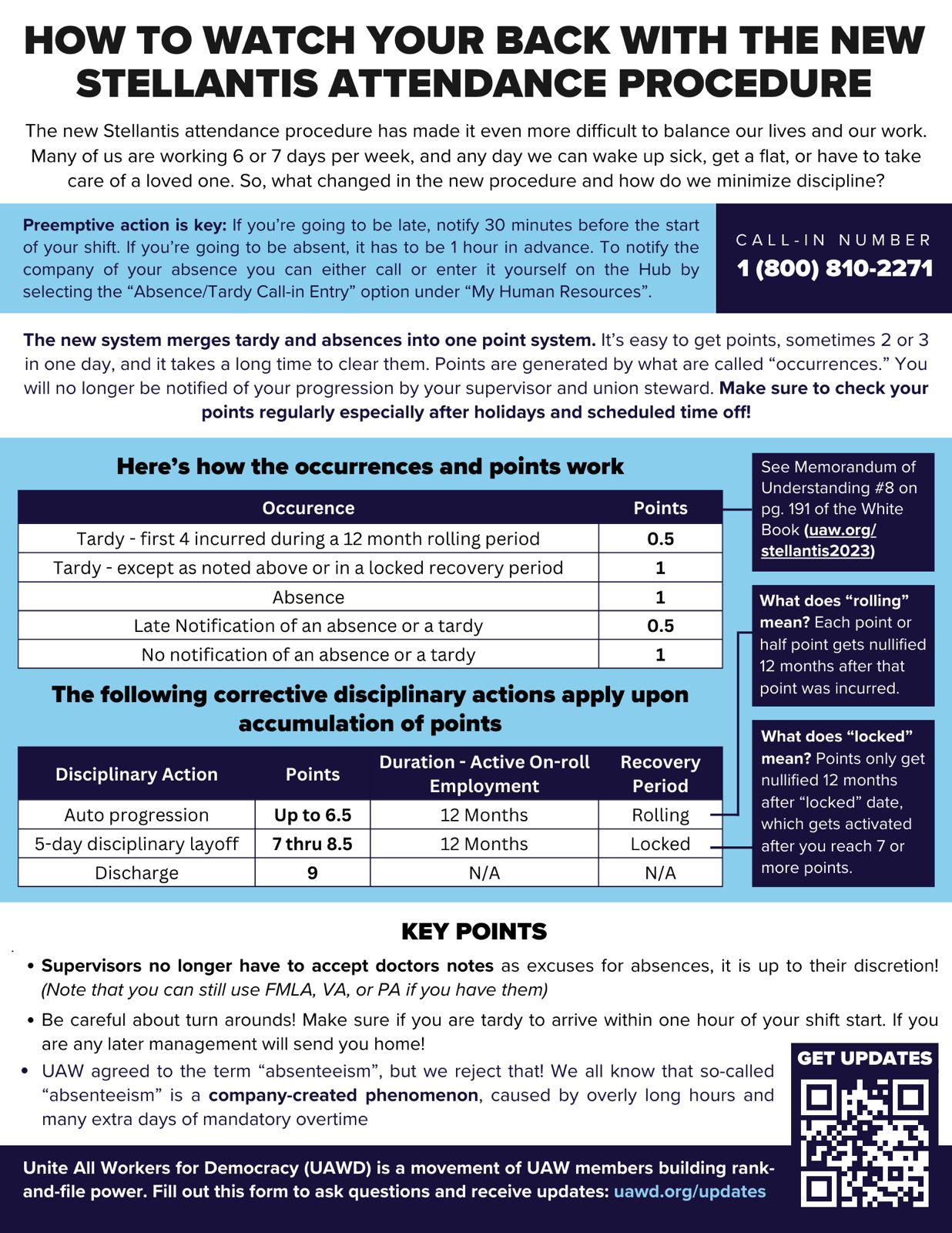
The rush to push out agreements for a vote meant that significant concessions were papered over. In the final hours before presenting the Stellantis agreement to the membership, Fain learned that the attendance policy provision had been weakened, merging ladders for absences and tardies, making it much easier to fire workers. Instead of telling members, Fain chose to move forward without mentioning it and recommended a Yes vote anyway—his last missed opportunity to demonstrate the behavior of top bargainers and build trust with the rank and file. Most Stellantis members only found out that their contract was weaker than the GM and Ford agreements in the months that followed ratification, as many faced termination for the first time in years.
The Stand Up Strike was a moment when Fain could have made a lasting break with the Administration Caucus rather than move closer to it. No matter the reasons why that break did not happen, the longer this alliance persists, the harder it will be to break out of it.
Allying with the Administration Caucus instead of empowering rank-and-file members
Our analysis of the Stand Up Strike is substantiated by Chris Brooks, Fain’s chief strategist in 2023. In detailing the approach the Fain administration took in advance of the strike, he describes the need to revamp departments in Solidarity House. Brooks’ only references to the membership are when he speaks of using the “organizing department to mobilize members” and “ensuring top staff and department heads could articulate Fain’s vision for a fighting, member-driven UAW.” He describes a retreat with senior staff and elected officials, recalling that “bargaining teams from around the country were brought to Detroit to roll out the ‘Members’ Demands,’” a document created by Fain and his senior advisors. These bargaining teams, elected months before Fain, were drawn entirely from the ranks of the Administration Caucus that he had just defeated—they were an extension of the top staff whose aim was to make things hard for Fain, not a gateway to the rank and file.
Brooks explains the immense challenge of trying to make dramatic changes quickly with hostile personnel, especially with only several months between Fain’s election and the contract expirations. This difficulty, and the feeling that only a positive outcome could give Fain the capital to move forward, is what gave top staff leverage to co-opt Fain’s new team: if they block you, you’re screwed. So we shouldn’t be surprised that, when they did block him, Fain decided not to try to bypass the bureaucracy, engage the rank and file directly, and have a chance to win big—risking that the bureaucracy might quash the strike and that the resulting contracts might be compromised. Instead, Fain pivoted to making the top Administration Caucus leaders his closest allies.
Brooks’ retrospective tells the story of Fain’s return to the bureaucracy very well: there was only limited strategy for engaging the membership, much less for empowering the rank and file to determine the path of escalation and lead it in their Locals. Instead of building member support to take risks, Fain mitigated the pressures imposed by the bureaucracy by allying with the Administration Caucus, ultimately becoming its new leader. Whether intended or not, the story Brooks tells is that Fain’s focus from day one was on reforming the bureaucracy, not transforming the UAW into a class struggle union that can one day be led by the rank and file.
For many unionists, the Administration Caucus has been the quintessential example of business unionism. For decades it had a developed political life and written internal rules, but, even as its formality waned in recent years, it continued to hold official “Administration Caucus meetings” at Constitutional Conventions and at key Regional meetings. Membership or allegiance was necessary to get pulled off the shop floor and appointed to a staff position or to move up the ranks. Fain considered himself a member of the Administration Caucus for years, like all UAW staff, prior to and during his appointment to the Stellantis Department (previously the Chrysler Department). His break with caucus leadership during the peak of the post-2008 concessionary contracts, denouncing the givebacks and saying, “two-tier wages have no place in this union,” put him on the outs with top UAW officials, but even then there was no alternative to being a “caucus member.”
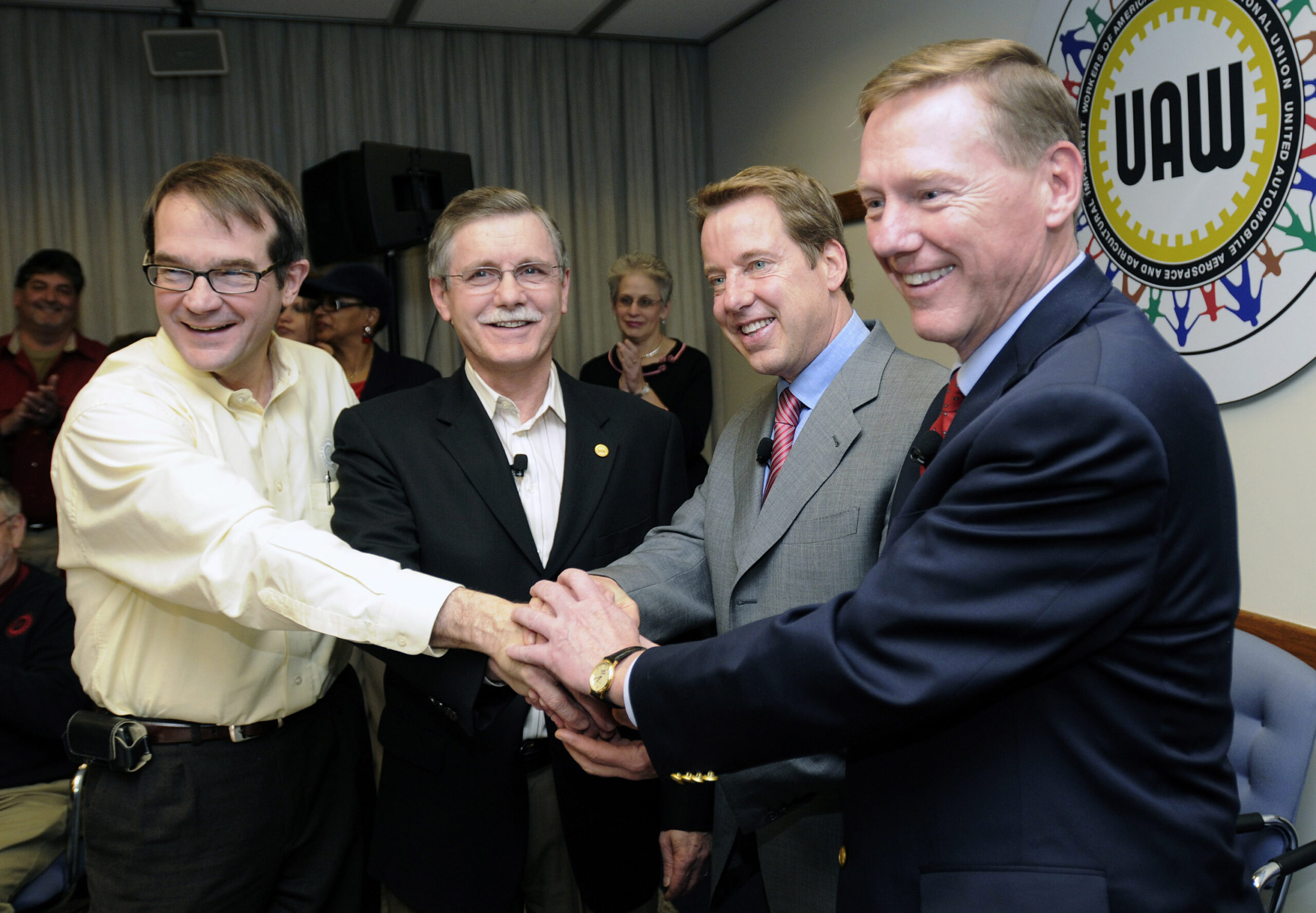
Historically, the Administration Caucus has not always been a conservative force, but it has always been willing to quash shop floor militancy and cede worker control to the bosses in return for stable contracts and preserving jobs. During the early years of Walter Reuther’s Administration Caucus, the UAW’s 1950 Treaty of Detroit began a bureaucratic period accepting corporate-labor peace and calling for improved corporate profitability in exchange for substantial, though ultimately diminishing, economic gains and dropping the fight for a shorter work week. Indeed by the 1960s, the caucus was well known for trying to keep the lid on wildcat strikes and other forms of worker militancy. As economic conditions grew tougher for manufacturing workers starting in the 1970s and 1980s, UAW leadership turned to concessions, abandoning the struggle on the shop floor and working with the company instead of fighting it. They also established the joint programs partnerships with the Big 3 automakers that undermined union independence and became the site of a massive corruption scandal decades later. By the time of the aftermath of the 2008 recession, the long-engrained concessionary mindset of the Administration Caucus meant that UAW leadership pushed for an end to pensions and the deeply damaging establishment of the two-tier system, all in the name of “living to fight another day” at all costs.
The reality of the Administration Caucus’s long reign over the UAW, and the union’s survival as a leading North American union, can be viewed as a “competent” business unionism that held a real appeal to Fain, a new president trying to direct power in the union. While this kind of labor politics has ultimately diminished the power and independence of the working class over the decades, it has also been wielded in periods as a progressive force in broader society. Walter Reuther used his business unionist relationship with management and the top-down structural relationship with membership to both extract economic concessions from the bosses as well as oppose segregation and ultimately the Vietnam war. Bob King’s presidency in the early 2010s was notably progressive in its internationalist rhetoric, a marked difference from the years prior, a continuation of his activism in opposition to U.S. intervention in Latin America and in support for migrants at the Southern border. But nothing changed in regard to the UAW bureaucracy’s engagement with the bosses or its approach to membership. In this light, Fain’s presidency can be seen as a more militant extension of King’s presidency, the progressive face of the Administration Caucus in the present political moment.
The election of Shawn Fain and the Members United Slate was hailed at the time as the end of seventy years of Administration Caucus rule in the UAW, but Fain and his small core of trusted staff appointees stepped into Solidarity House with the vast majority of the people there shaped by a caucus hostile to the ideas he promoted and the opening that his election represented. Brooks describes, however, that “after seeing how divided the union was at the Special Bargaining Convention and how short our runway was to Big Three bargaining, Fain decided against cleaning house.” Whether that decision was made out of fear of not being able to advance their program or a genuine belief that Fain and his team could make inroads, leaving most top Administration Caucus staff in place left a major foothold they could continue to exploit through another decades-old quality of the Administration Caucus that remained alive and well: their repressive behavior used to enforce top-down decision-making.
In this light, Fain’s presidency can be seen as a more militant extension of King’s presidency, the progressive face of the Administration Caucus in the present political moment.
The authors have multiple accounts from staff from 2023 of top staff and Administration Caucus electeds embroiling Fain’s new appointees in minor scandals that undermined work and sowed division within Fain’s new team. For example, during a Communications Department trip to a shop in bargaining, a new Fain appointee who had been a member of UAWD was accused by Region 4 Director Brandon Campbell of violating staff guidelines by advertising UAWD to rank-and-file members present as they gave their introduction—but the appointee hadn’t even mentioned UAWD, and Campbell provided no evidence that they had. Instead of dismissing the meritless claim, Fain’s new Communications Director, Jonah Furman, told the appointee it was their responsibility to rebut the claim and pressured the appointee to produce a lengthy write-up of their activities from the trip. This kind of conflict was repeated to embroil new appointees and Regional Directors aligned with Fain in tense, chaotic work dramas, creating a cycle that further pressured Fain and his team to capitulate and ally with the bureaucracy. The outcome, as mentioned above, is that Campbell, once the chief repressor of Fain’s new team, is now Fain’s top running mate for re-election.
Whether he had these attitudes before his presidency or not, Fain’s alliance with the secretive Administration Caucus has aligned with his tendency not to share information regarding internal political disputes. A variety of conflicts with other top UAW leaders, over austerity and mismanagement, have been kept siloed within the bureaucracy instead of being brought publicly to the rank-and-file. The major crisis of Fain’s presidency is an ongoing dispute with Secretary Treasurer Margaret Mock and Vice President Rich Boyer, both running mates of Fain’s on the Members United slate. In pushing for the removal of Mock’s discretionary offices, Fain had a clear political justification, including Mock’s undermining efforts leading up to the Stand Up Strike and other examples of misconduct, and he had a clear procedural basis to do so through an IEB vote under the UAW Constitution. The case for Boyer’s removal as head of the Stellantis Department was similarly clear, both politically and procedurally, with Boyer’s concessionary dealmaking resulting in a harmful inferior attendance policy and failures to secure product commitments.
For both of these conflicts, Fain had the receipts, with a lengthy IEB debate citing the facts about Mock and an extensive internal memo citing the facts about Boyer, but he refused to speak publicly—and even pressured UAWD not to share the information we had. Fain’s secrecy not only gave Mock and Boyer the sole megaphone, as they shared their full narrative with the press and on social media, it also emboldened court-appointed Monitor, Neil Barofsky. Barofsky launched an investigation of Fain in his search for a way to attack Fain after the UAW took a position in support of a ceasefire in Gaza that offended Barofsky. Instead, Fain could’ve himself gone public, in one of his well-watched Facebook Live appearances, and made the case to the rank and file, explaining that his actions weren’t self-serving but were to reinvigorate UAW militancy.
But Fain again took a risk-averse approach, believing that having a good argument and not “airing dirty laundry” from within the bureaucracy would insulate him. The result is that the UAW membership, rightfully, feels uninformed about a complex set of accusations and that Fain’s public silence has driven many to take the side of Mock, Boyer, and the Monitor, who support an apolitical, austere vision of unionism.
Instead of engaging the rank and file, Fain has pushed his agenda and his administration’s piecemeal militancy from the top down. Fain became ensnared by the Administration Caucus as he fought battles both inside and outside the UAW, and so chose to work with and enable a small staff core to maintain a stranglehold on how decisions are made and resources are allocated. Whether it’s genuine political opposition to developing a class struggle approach, fear that he’ll lose control of the UAW, or lack of vision, Fain responded to the pressures on him by allying with the UAW’s business-unionist old guard, putting forward militant rhetoric instead of leading and empowering members to take militant action.
Militant rhetoric, failure to back it up with action
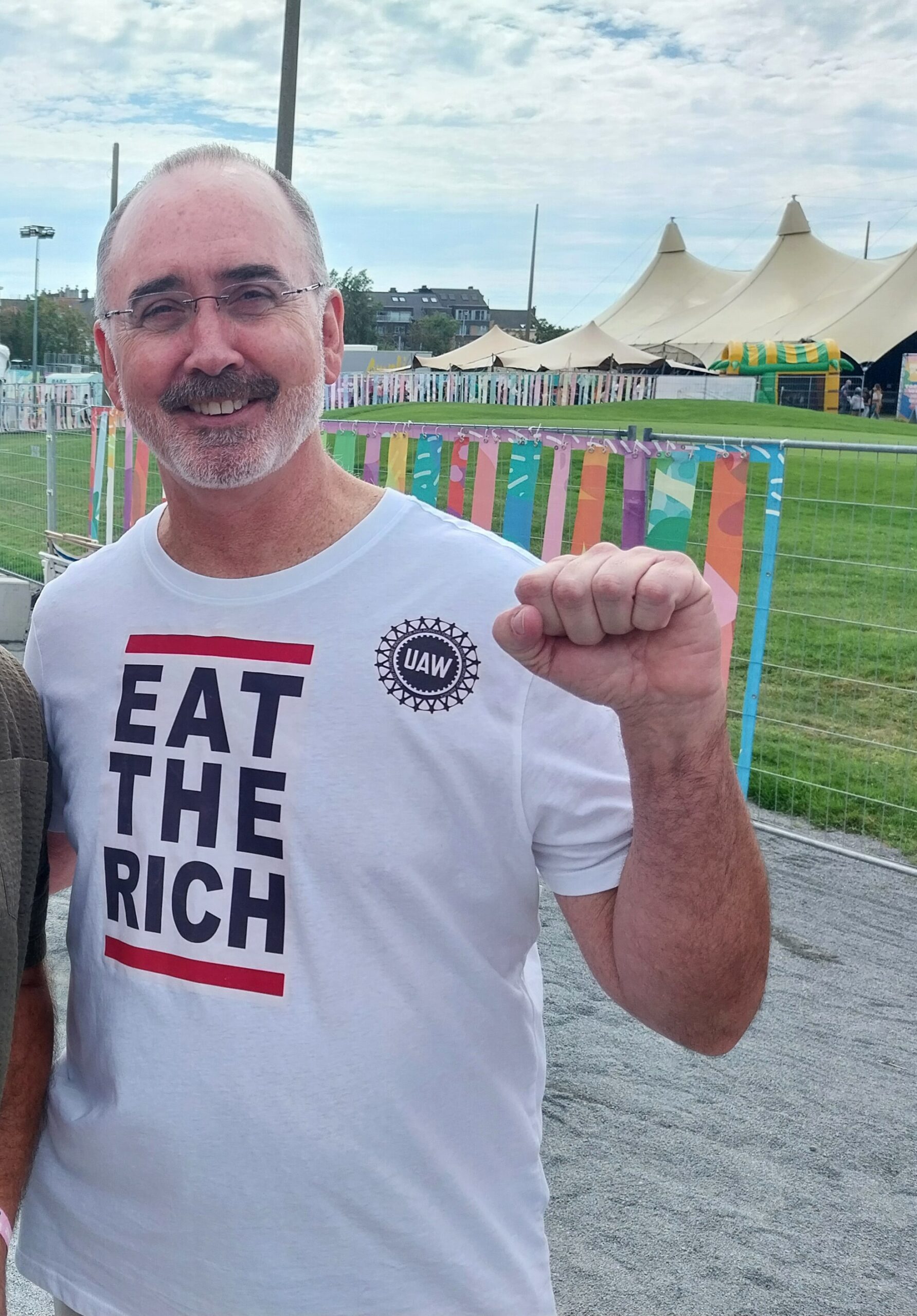
Fain’s rhetoric—featuring militant slogans like “Eat The Rich”—has been more reflective of a class struggle approach than that of any UAW president in decades. Fain regularly talks about the need to fight, asserts that “working-class people deserve dignity,” and denounces the “billionaire class” for exploiting workers and undermining democracy. He eloquently calls for working-class solidarity that transcends race and nationality—for example, when he has compared his grandparents, who migrated north to find manufacturing jobs in the Midwest, to undocumented workers from south of the border seeking to earn a living for themselves and their families in the U.S.
But Fain and his administration haven’t backed up these words with actions that could have moved forward key campaigns and transformed our union by empowering rank-and-file members to take the fight into our own hands. The failure to take action that matches his militant language shouldn’t be a surprise—allocating funds for big strikes and undermining long-time UAW staff to send resources to train up rank-and-file organizers would anger his Administration Caucus allies, who benefit from the status quo.
What was once declared as Fain’s plan for a “general strike” on May Day 2028 is the prime example of a commitment for a campaign that has not only gone unrealized, but has even been rhetorically rolled back. In 2024, Fain said “There’s been talk about a “general strike” for as long as I’ve been alive. But that’s all it has been: talk.” Instead, if the labor movement was serious, “we need to spend the next four years getting prepared.” Fain’s call initially sent a wave of energy across the progressive wing of the labor movement, changing the conversation about what was possible for many militants. The American Federation of Teachers, led by the Chicago Teachers Union, heeded the call to align contract expirations for May 1, 2028.
Fain understands the reality that no union leader or bureaucracy can will a general strike into existence. He has explained that “a general strike isn’t going to happen on a whim. It’s not going to happen over social media. A successful general strike is going to take time, mass coordination, and a whole lot of work by the labor movement.” But if Fain was ever serious about the goal of a 2028 general strike, he didn’t pursue it. Why? It would’ve been too big a risk to challenge the bureaucracy by deploying the resources required for pursuing his vision and empowering rank-and-file leaders needed to mount a bottom-up effort capable of realizing a general strike.
In practice, the Fain administration has never materialized the hard work of meaningfully organizing within the working class to build the capacity for a general strike, organizationally and politically. It never even took the early steps of political education within the UAW rank and file. Fain never toured major manufacturing plants to describe the plan to members and never called for Local leaders or rank-and-file members to lead practice pickets on May Day in 2025 or 2026, meaning that even in the few cases the UAW participated in May Day rallies this year, very few members were even aware. The Fain administration never created resources for interested members to disseminate about May Day at their shops. The administration certainly never enabled membership deliberation and votes about what fights could or should spark general strike, like responding to violent attacks by ICE on the working class in their community. And now even the idea of the UAW organizing for a general strike is no longer mentioned by the Fain administration. In recent prominent settings, like the UAW’s Michigan Governor’s Forum, Fain refers to a “big fight coming on May Day 2028” and continues to passively say “we’ve invited unions around the country to align contracts with us,” but avoids mention of a “general strike.” Fain’s re-election literature doesn’t even describe a plan for a strike at all, simply saying that “in 2028, we are headed back to the table to finish the job.”
The other major campaign that the Fain administration has withdrawn from is the drive to organize Southern auto plants, which Fain deserves credit for initially reinvigorating and spurring on. This resurgence of organizing emerged from the enthusiasm of the Stand Up Strike and culminated in what looked to be a pathbreaking victory by Volkswagen workers in Chattanooga, but which now appears to have been largely abandoned after the narrow loss by Mercedes organizers in Alabama. Fain and his team claimed, and may have genuinely believed, that the only way to organize the South was moving quickly, using “momentum-based organizing,” an approach that “scales up quickly by prioritizing mass sign-ups, rapid mobilization, and decentralized leadership.” The stated strategy, in which “the primary responsibility for building the organizing committee and the campaign needed to win is placed on workers themselves rather than professional organizing staff,” is a refreshing shift from the top-down organizing model used by the UAW for decades.
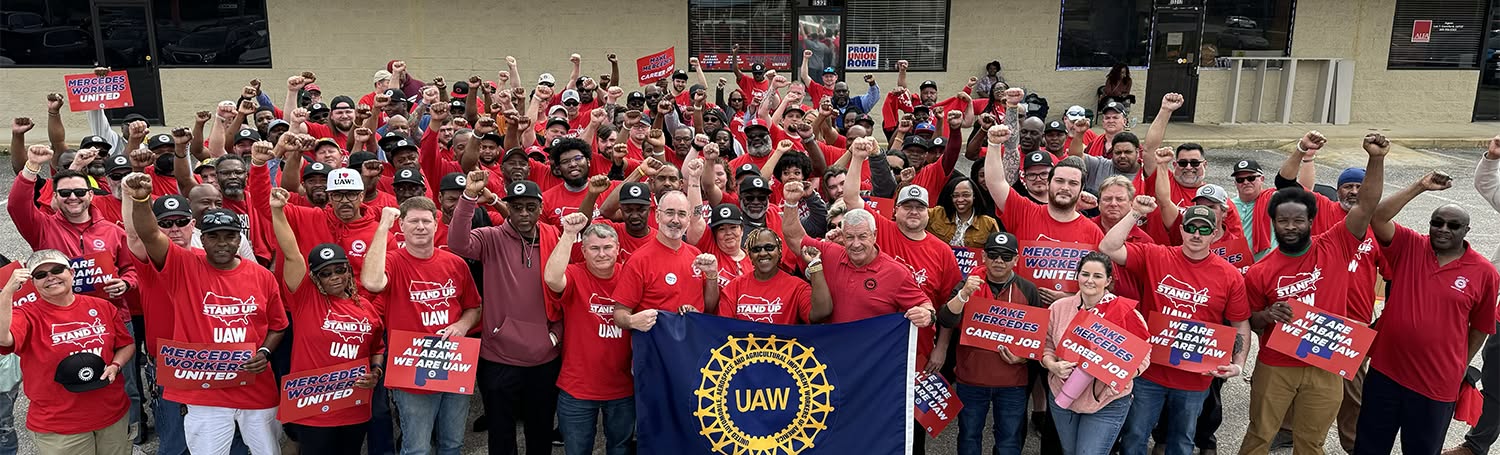
But the need to work fast also conveniently meant that the Fain administration needed to look to established staffers to anchor the campaign and couldn’t take the time to build up a new rank-and-file layer of Southern leaders. The result was an organizing approach that didn’t look very different from the past, with the Organizing Department quickly recruiting a small group of staff, consisting largely of West Coast organizers from the higher education sector, to deploy to the South. Instead, the millions of dollars spent on well-salaried staff could have been invested in a long-term rank-and-file training program, giving Southern organizers who are committed to working in their plants for years to come the opportunity to attend multi-month organizing schools. This would’ve been a years-long effort at minimum, no doubt, but would’ve made worker-leaders the gateway to empowering their coworkers.
Now even the staff sent to the South are being withdrawn. Echoing anecdotes shared by organizers across the South, a UAWD member leading an organizing drive at a plant in Alabama recently commented, “I feel there was a ton of enthusiasm from International at the start, but when things got hard, like they inevitably do in new campaigns, they kind of folded to the adversity. We don’t dislike our staff, they’ve just been hard to reach for months, they’re managing multiple campaigns across the South and they’re not down here that much. They sometimes have advice for us when we get them on the phone, but, beyond that, there aren’t organizing resources flowing to us as workers.” The single loss at Mercedes didn’t change the terrain for new organizing in the South, which was already incredibly challenging, but the perception of a shift in momentum changed Fain’s calculation about what he could invest in it without risking his new alliance and role as leader of the Administration Caucus. By withdrawing organizing staff, the result is that there isn’t even capacity for a sustained top-down campaign. More importantly, there isn’t a new layer of local leaders who are being trained up in preparation for a long-haul bottom-up initiative.
There are other rhetorical commitments Fain has made that have not resulted in action. The UAW under Fain has also publicly shown support for the Palestinian people but has balked at translating verbal commitments into any kind of consequential action—for example, failing to divest UAW members’ dues from Israel Bonds and to heed the call of the Palestinian General Federation of Trade Unions for unions everywhere to “use all possible means to halt the ongoing holocaust to which our Palestinian people are subjected daily, and to prevent the US administration from supplying this occupation with weapons.” Meanwhile, the Divestment and Just Transition Working Group that the IEB voted to form two-and-a-half years ago has shown no sign of materializing.1
Fain also hasn’t explained his strategy for his campaign trail call to fight in between contracts for core issues that impact members’ working lives. High on the list has been the claim that the UAW should fight for work-life balance and call for a 32-hour work week. Fain has failed to put forward a vision for how the UAW can take action to fight management’s rights to mandate overtime and lay off workers at will, which are deeply ingrained and largely unquestioned provisions of the UAW’s largest manufacturing contracts. Calling for an expansion of our union’s role to include the fight for control on the shop floor would prompt members to consider alternatives to layoffs like work-sharing provisions, which were once common in U.S. labor contracts.
One way to agitate rank-and-file members to build power at plants where they’re overworked or have had to suffer long layoffs is to wage protected mid-contract strikes, a militant strategy called for in the UAWD’s 2026 IEB Endorsee Program. On the campaign trail in 2022, Fain alluded to using these strategies, but since his election he has not worked to advance these strikes. With the power of the UAW presidency, Fain has had ample opportunity to use staff, legal, and communications resources to educate local leaders and rank-and-file members about using levers like work-to-rule campaigns and strikes over production standards and health and safety grievances. This approach would give members the tools to treat hollowed-out contracts as a floor from which to fight for more, not a ceiling.
The limited view of unions as responsible for maintaining labor peace is no simple thing to overcome, as the UAW bureaucracy’s concessionary approach has given the bosses control over UAW members’ lives for years and created a context in which members, often unhappy about the loss of control over their lives, find it difficult to imagine that the status quo can be fought. The Fain administration couldn’t have changed that in a single term, but it could have built a foundation for the rank and file to change it in the years to come.
No union leader has a magic bullet to build a fighting union or win better conditions for the working class, on or off the job, in the U.S. or around the world. Leaders can’t snap their fingers and pressure rank-and-file members into militancy or force concessions from management. What visionary union leadership can do is invest time and resources in organizing rank-and-file members, train members up with skills and know-how that are typically held only by staff, and vest members with collective decision-making power so that they can choose democratically how to use their resources and wield their power. But this type of long-term commitment that undermines the bureaucracy only comes from identifying class struggle unionism as a core component of advancing the working class, coupled with politically educating rank-and-file members and inviting members in to develop class struggle strategy in their shops and communities.
Catering to the ruling class, instead of building working class independence
A class struggle unionist outside the UAW might think, “Sure, Fain has made some big compromises and re-established the old guard bureaucracy, but isn’t it all worth it if the outcome is an independent UAW that starts fighting again?” Most likely not, because being subsumed back into the UAW bureaucracy is part and parcel of the Fain administration’s cozying up to political elites in the Democratic and Republican parties.
Instead of promoting political independence, engaging UAW members to deliberate over political endorsements, and ultimately being able to withhold electoral support as leverage in negotiations with politicians, Fain has charted the traditional electoral strategy of supporting the Democratic Party. In 2024, the Fain administration chose to endorse the Biden and then Harris campaigns, initially endorsing Biden in January of that year even as he insisted the UAW’s endorsement needed to be earned. When Fain appeared at the Democratic National Convention and said “Kamala Harris is one of us,” implying her support for the working class, he lost the confidence of many UAW members across the political spectrum who knew she represented the ruling political and corporate elite, even if they chose to vote for her as the lesser of two evils. In comparison, a mixed statement like United Electrical’s would have been a significant advancement—UE recommended “that workers strategically vote against Trump by voting for the only viable candidate running against him—which is now Kamala Harris,” but then said clearly, “working people desperately need an independent political organization, based on a political program that can unite us, which can fight for that platform in the electoral arena.” Meanwhile, Fain has been silent on the idea of a future “labor party” or “working class party,” something that many rank and file members resonate with on the shop floor.
Many UAW members might have respected both the UAW leadership and the UAW as a whole if they, as workers, had had the opportunity to debate and engage in collective decision-making about who the UAW would endorse for the US President, even if their perspective ultimately lost out. With over a year to plan after he came into office, Fain could have put together mass town halls to get worker input, and he could have conducted a membership-wide referendum, allowing UAW members to choose between endorsing the Democrat, the Republican, or neither—helping build the basis for collective deliberation and effective political education, necessary to understand that neither of the two major capitalist parties represents the working class.
But in line with Fain’s risk-averse top-down approach, he chose not to adopt a long-sighted view of developing a class struggle union and empower the UAW rank and file to determine our union’s political direction. Instead, Fain stuck with the imperative to bolster the Democrats, a decades-old Administration Caucus norm and the status quo for the U.S. labor movement. Just like UAW top leadership has done for decades, Fain has overseen the disbursement of over $1 million per year to the Democrats, funding which could have gone to new organizing, political education, and other working class priorities.
While the Fain administration went all-in for the Democrats in the 2024 presidential election, and Fain made fiery comments about Trump on the campaign trail, denouncing him as a “scab,” Fain quickly declared he was “ready to work with Trump” immediately after the election and has since tempered his rhetoric with conciliation regarding economic and trade policy. Fain’s support of Trump’s chaotic tariff policy further reveals the misunderstanding that the union’s strength can grow from aligning with the ruling class and whichever party is in power. The UAW’s current position is similar to the position the Administration Caucus long took during the UAW presidencies of Owen Bieber and King, who opposed the North American Free Trade Agreement but could not resist the industry’s restructuring that massively weakened labor power. The Fain administration has called for a cross-border wage floor to combat offshoring while improving lives for auto workers abroad, but it hasn’t taken action to organize rank-and-file members to fight for company-wide wage floors in UAW contracts.
For Fain, aligning with the old guard internally has gone hand-in-hand with the decades-old appeasement of the two ruling parties.
Trump’s tariff policy undermines international solidarity among North American auto workers necessary to rebuild working class power, and the Fain administration’s tariff strategy and emerging concessionary approach to addressing U.S. job cuts is playing right into the major automakers’ whipsawing strategy. Last year when describing the relationship with Trump on tariffs Fain said, “GM, Ford, and Stellantis have excess capacity in their U.S. auto plants” and that “shifting more auto production to the U.S. could add tens of thousands of manufacturing jobs.” Fain recently cheered the move of thousands of Canadian auto jobs to the U.S. as Stellantis closed the Brampton Assembly plant, partly due to tariff pressure. Rather than using the opportunity to organize across borders against plant shutdowns or fighting for work sharing to reduce the harm from layoffs, this zero-sum strategy allows corporations to pit workers against each other, weakening the working class in the long run.
The Fain administration’s fear of clashing with the political elite even emerges in small ways, for example, after a Ford worker and Local 600 member heckled Trump and called him a “pedophile protector” while Trump toured his plant. The member was suspended and had his job threatened by Ford, without management citing any violation of the UAW-Ford contract. While she stated that the suspension was illegitimate, Laura Dickerson, now Vice President over the Ford Department, waffled politically. Dickerson, one of Fain’s antagonists-turned-running-mates, spoke about the issue in the long legacy of Administration Caucus conciliatory business unionism: “As far as manufacturing, we have tariff issues, we’re trying to work with the administration on that—they’re listening to us … We’re doing a lot of work with the Trump administration, so it gets tricky.”
The CBS News Detroit reporter summed up the Fain administration’s approach to catering to the ruling class effectively: “The UAW is walking a fine line. The union is there to represent its workers, but it also wants to see the companies that employ those workers do well financially, all while they have business in front of the Trump administration too.” For Fain, aligning with the old guard internally has gone hand-in-hand with the decades-old appeasement of the two ruling parties.
Class struggle unionism is rank-and-file unionism
UAWD’s leadership of Fain’s election campaign victory in 2023 is the reason that there’s been renewed language of militancy in the UAW. But determining the difference between traditional business unionism and the progressive bureaucratic approach that Fain’s administration has taken is less significant than the question of what a serious commitment to class struggle unionism looks like. Whatever Fain’s political motivations were when he entered office, his decisions since then have actively distanced him from a class struggle orientation.
Ultimately, the Fain administration never had a plan for prompting long-term struggle and building power in the Locals or amongst the rank and file. There was no plan to transform the incentive structure within our union to one where class struggle fighters on the floor can win out over long-time staff and Local bureaucrats. Fain could have committed to a risky direct confrontation with the bureaucracy, appearing in-person at every plant experiencing mandatory overtime and every shop heading into a contract expiration without a clear plan for a strike. He could have engaged directly with the rank and file, knowing it would put him in conflict with entrenched Local leadership, and committed funding and resources if Local memberships voted for militant action.
Fain had two real options: 1) invest in developing a new layer of class struggle Local leaders, and risk losing re-election but in order to create a militant rank-and-file generation in the UAW that could win out by organizing and energizing their coworkers in the years to come; or 2) re-entrench the staff-led Administration Caucus by allying with it and becoming its new head, making the compromises necessary to be able to take some action now and avoid backlash. He picked the latter.
As experienced rank-and-file organizers in the UAW’s four core sectors, we know that our coworkers aren’t apathetic. Across the UAW rank and file, and the working class as a whole, we see a deep frustration with the kind of politics that dominates our two-party system and entrenches our bosses’ control over our lives. Most of our coworkers may not share our full analysis, and, in this moment of still very limited class struggle, even the angriest are sometimes not ready to fight today, knowing that our union won’t have their back and lacking experience leading independent shop-floor struggles.
We also know that rank-and-file members across the country, and across the political spectrum, are ready to be part of a struggle against their bosses and need only the tools and the confidence to organize with their coworkers. A UAW president committed to class struggle wouldn’t look to the bureaucracy, which has thwarted the struggle for decades, but would invest in years of training and political education at the shop-floor level to prepare for the long and difficult fight ahead, entrusting UAW members to take the reins on their own battles.
- After publication of this editorial, UAWD delegates successfully led the effort to win divestment from Israel Bonds on the last day of the 39th UAW Constitutional Convention. ↩︎